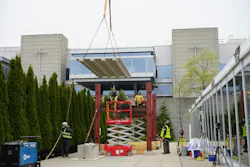
A full-scale prototype demonstrates low-carbon structural systems ready for commercial scale
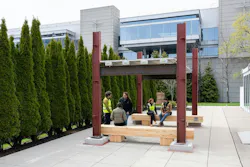
An exhibit at the Structural Engineering Institute’s annual conference aimed to demonstrate that the next generation of low-carbon structural building systems has gone from research concept to buildable reality.
A speciality institute of the American Society of Civil Engineers, SEI is the home of the SE 2050 Commitment Program, a voluntary initiative that calls on structural engineering firms to eliminate embodied carbon in all structures by 2050. Over 170 structural engineering firms in North America have signed the commitment.
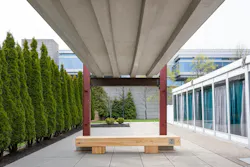
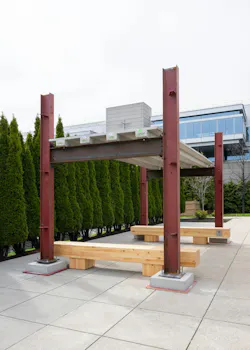
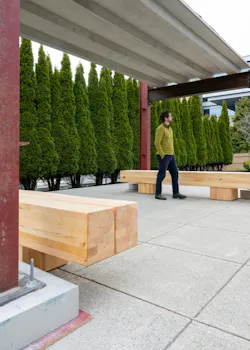
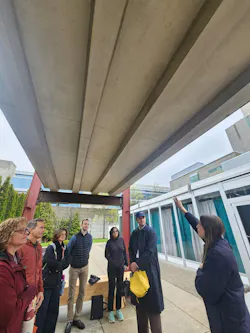
At Structures Congress 2026 in Boston, the exhibit, Reframing the Future, displayed the low-carbon structural materials and systems that can be used for today’s commercial projects. It also incorporated principles of circular economy, such as reuse, waste diversion, biogenic materials, and design for deconstruction.
Reframing the Future was organized in partnership with Buro Happold, Cambium Carbon, Forma Systems, Second Structure, Turner Construction Company, and the Digital Structures research group at MIT.
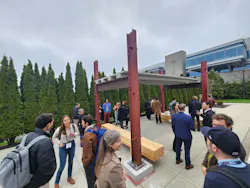
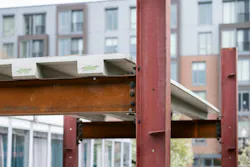
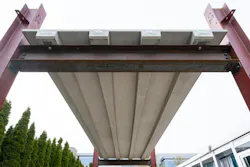
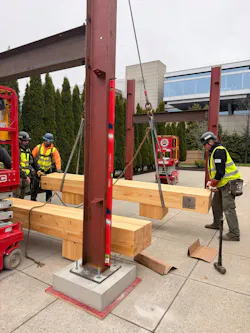
Using the following three material strategies, the full-scale prototype achieved cost, speed, and carbon benefits, and weighed about 3.5 tons, over 50% lighter than a similar cast-in-place concrete system.
- The exhibit’s reinforced concrete floor slab, developed by Forma Systems in collaboration with J.P. Carrara, integrated shape optimization to use significantly less material while achieving the same structural performance as conventional concrete systems. Using reinforced concrete and steel only where structurally necessary, such floors can be lighter, shallower, and up to 70% lower carbon than conventional floors, according to a statement from Buro Happold.
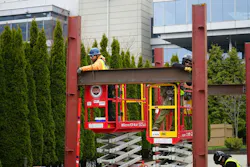
- Reclaimed steel, sourced by MIT Ph.D. student Juliana Berglund-Brown and Cora Structural and fabricated by Prime Steel Erecting, avoided the energy used to melt and recast recycled steel. The exhibit’s structural elements were salvaged from a nearby deconstruction project and traveled just over 60 miles.
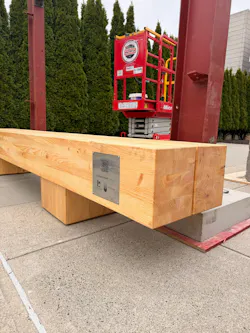
- The structure’s wood was made of Cambium’s source-verified material, which turns salvaged and underutilized trees into structural material. The glue-laminated timber beams were manufactured by Tridome Structures using Cambium’s urban salvage wood sourced within 4 to 30 miles of the site.
“What I love about this exhibit is that these structural products are readily available reinventions of traditional structural material,” Cambium’s Alexis Feitel said in the statement. “Circular, volume optimized, and local timber materials are right-now solutions to reducing embodied carbon.”
In addition to showcasing various materials, the exhibit intended to show that achieving low-carbon construction at scale requires alignment across the entire supply chain, beginning with material sourcing.