Life science construction: Ask 8 questions before investing

This blog post was authored by Melisa Vasquez, Project Director, CRB; and Mike Barrett, Vice President, Project Delivery Services, CRB.
Life science construction is poised for expansion. That’s what we learned when we surveyed 500+ company leaders to understand their perspective on where the industry is going next: 86% predict healthy growth over the coming years.
But with growth comes new challenges for the life science industry, such as choosing the right time to invest in capacity expansion projects or designing projects to deliver long-term value.
This article will help you overcome those challenges. The goal is to provide practical advice and tools to ensure that your next life science construction project meets the needs of your business, end users, and patients. To do that, we will answer eight common questions about life science construction:
Before beginning your life science construction project
1. What pre-work should I do before hiring a partner?
Your team will face a lot of decisions during the early phases of capital delivery. For example, you need to define your budgetary constraints, your timeline, and the conditions of satisfaction that your project must meet in order to be successful.
These decisions are all important, but you should start with the one that is most crucial for capital delivery success: deciding why you need this project, and why now.
Know what you’re building and why you’re building it
Starting a new capital project may seem unavoidable when you need to meet growing demand or achieve commercialization milestones. But… is it, really?
Before you commit to your project, get clear on why it’s necessary. That means understanding the business case driving it and exploring other viable pathways for meeting your objectives. If you’re facing a capacity crunch, for example, consider running an operations improvement study.
By analyzing your current facility and process, you may find ways to remove non-value adding activities and streamline key product flows, helping you achieve the productivity gains you need while deferring a significant capital expense.
If it is the right time to launch your new life science construction project, understanding the “why” behind it will help both you and your architecture, engineering and construction (AEC) partners align the project with your business objectives, ensuring good value and a successful outcome.
Know what you’ll manufacture in your new capital asset, and how
Every life science project is different, shaped by the unique opportunities and constraints of the products in play. This goes deeper than the broad qualities that distinguish a monoclonal antibody operation from a facility optimized for cell therapies—it’s about understanding your unique process and the unit operations behind it, and approaching your capital project with specificity rather than speculation.
Quantifiable targets play an important role here. Every project will involve projections and assumptions, but understanding the data-driven basis behind those assumptions will help you spend your capital dollars more effectively.
2. What will my construction firm need to know to future-proof my project?
Question #1 asked about the business drivers behind your project and the products and processes needed to make it. Now it’s time to develop a vision for how this facility may evolve in the future.
Planning for the appropriate level of flexibility ensures your facility will remain useful and valuable for many years. You may choose to undertake this pre-work with guidance and expertise from your AEC partner, whose experience on other life science projects may offer a useful perspective on how to future-proof your own capital asset. The goal is to define several aspirational parameters, including:
The highest level of product development you anticipate accommodating in this facility
Perhaps you’re focused on R&D today, but you anticipate commercializing in the future. Wherever you fall on that spectrum right now, get clear on where you plan to go next. This will give you and your AEC team the information needed to prepare for rapid future adaptations and expansions.
The scale or throughput of your desired operation
Scaling from clinical production to commercial volumes is more than a matter of adding bigger equipment and more space. It requires looking at your process from a GMP perspective to ensure not just regulatory compliance but also the efficiency, productivity, and reliability of your operation as your throughput grows.
For some manufacturers, meeting those throughput needs might require upgrading to larger equipment. However, for others, like those making personalized therapies, scaling out may be the only option.
Each scenario introduces significant complexities in equipment selection, facility size and layout, and automation strategies. Planning for these future scenarios from day one will allow your AEC team to set aside space, utility hookups and other key features, enabling rapid integration of new capabilities or expanded capacity as the need arises.
How you see this facility growing or changing in the next 5, 10, or 20 years
Besides planning for scalability in processes and products, your success also relies on your overall vision for this facility. After all, this is a long-term asset. It’s important to understand what you can do today to ensure that it continues meeting your company’s needs long into the future.
A strategic facility planning process can help you answer this question from a data-driven perspective, whether that means leveraging your own historic space management and utilization insights or, in the case of new companies, using hypothetical data based on comparable projects. The goal is to forecast future business and market drivers and analyze how all areas of your facility—from your warehouse to your manufacturing areas, your amenity spaces, and even your parking lots—will need to grow or adapt in response to those drivers.
From that vision, you can strategically define how much space and infrastructure you need during initial project phases, and how much can wait for a future project phase.
3. What should I look for in a life science construction company?
Every AEC company brings unique value to the table. But when you’re under pressure to meet your speed-to-market goals by getting a complex life science project up and running smoothly, sifting through your options and making the right choice (right now!) can be a challenge.
Look for expertise specific to the life science industry
Any skilled commercial builder could deliver a facility that functions as designed, but functionality is table stakes in the life science industry. What drug manufacturers need goes much further. You need a complex environment that integrates both regulated manufacturing areas and non-technical spaces under a single roof. You may also need to accommodate a multimodal pipeline, handle future expansions as demand changes, or meet sustainability benchmarks while adhering to rigid GMP requirements.
It takes specialized knowledge of life science manufacturing to bring all of these elements together. With that in mind, look for an AEC partner that offers expertise in:
- Process engineering: Find an AEC team with a strong understanding of manufacturing for the life sciences in general and a commitment to understanding how your process works in particular.
- Scale-up and scale-out: An AEC team that understands the clinical-to-commercial pipeline for new products can help you scale your operation smoothly.
- Sustainability and energy efficiency in life science facilities: It’s easy to set sustainability benchmarks—much harder to meet them, particularly in the context of a regulated, energy-intensive commercial life science facility. Find a partner with expertise in this area who can help you balance your sustainability KPIs with GMP requirements.
- The regulatory landscape: Depending on the type of product manufactured in your facility and the markets in which you’ll distribute it, you may need an AEC partner who understands regulations and guidance documents.
- The technology landscape: With new and evolving life science manufacturing technologies emerging all the time and manufacturers pushing for sophisticated automation strategies that feature artificial intelligence and machine learning, it’s never been more important to work with a partner who understands the technologies available today—and where they may be going next.
- Planning for future constructability: It’s not uncommon for life science manufacturers to carve a large, multi-year project into discrete phases, putting attainable milestones within reach while planning for future expansions as financial resources become available. For this approach to work, however, project teams must consider the sensitive nature of a life science manufacturing environment, and the impact of future construction activities on ongoing operations.
Look for an AEC firm who asks “why”
In addition to the technical qualifications of your AEC team, do a “vibe check”. Ask yourself if you can envision working alongside this AEC team for months or years to come. Ensure that they bring energy and enthusiasm to the project planning table, and that they demonstrate curiosity.
It’s easy to undervalue curiosity as a key trait of a successful AEC partner, particularly in the life sciences industry where so much rides on technical know-how. But the partner who is willing to ask “why”—and to help you find the answer—is the partner you want. Rather than simply follow a predetermined path, they will ensure that your capital project is truly necessary, right-sized, and aligned with your goals from start to finish.
You’ll find clues about your AEC partner’s level of curiosity during your early conversations with them. For example, look for a partner who starts by asking why you’re building a new facility. By openly exploring that decision with you, they may help you discover a simple process modification which could generate the productivity gains you require without a major capital expense. They may also help you see why one site is more aligned with your long-term vision than another, or why “the way you’ve always done it” is no longer serving your business needs. Having a partner who is actively engaged in the “why” behind your capital investment will add immense value to your project.
4. Which contracting strategy should I apply to my project?
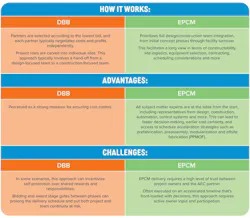
Although the design-bid-build (DBB) method is well-established across industries, the advantages offered by an engineering, procurement and construction management (EPCM) approach are significant.
This is especially true for life science manufacturers, who face an uncommon level of complexity and risk as they move through the project delivery lifecycle.
During project execution
5. What should I expect during a life science project kick-off?
“Begin as you mean to go on.” For experienced project delivery teams, those words hold weight. Small missteps and shortcuts may seem innocent early in the delivery lifecycle, but their consequences can have an exponential influence on a future project deliverable, causing slow-downs, rework, and lost opportunities for project optimization. In short: the success of a complex life science project depends upon the diligence applied to its early planning phases.
To ensure a strong project launch, your AEC team will begin by seeking to understand the business drivers and success factors that impact your project, particularly those described in Question #1: the why, the what, and the how behind your capital investment.
Your AEC team may have a formal process to help them reach that shared understanding and build consensus around the project’s criteria and objectives. At CRB, we refer to this as the chartering process.
Successful projects begin with a project charter
The chartering process is designed to build alignment between organizational leaders, end users, design and construction leads, trade partners, and other stakeholders, particularly in relation to a project’s goals and the best way to achieve a successful outcome from both a business and a technical perspective.
During the chartering phase, the delivery team has an opportunity to plan for project-specific challenges, such as supply constraints (ex. working around long lead times for equipment), location-related issues (ex. moving materials to and from major travel hubs), and more. This is also an opportunity for team members to define how they will work together, the lean tools they will use, and the project’s conditions of satisfaction.
Ultimately, the charter is a roadmap for success. By establishing it early, your AEC team creates an environment in which all project stakeholders are moving in the same direction.
6. What goes into a successful life science facility design?
There are many factors that go into developing a robust, compliant, and flexible life science manufacturing plant which delivers on both patients’ needs and the needs of your business. A well-chosen AEC team will help you coordinate each of these factors and make decisions along the way that align with your vision and contribute to a successful outcome. These decisions vary from project to project, but in general, your AEC firm may focus on:
- Planning for future integrations and technologies
- Ensuring scalability and optimal efficiency
- Attention to non-technical spaces
7. What are some of the common challenges during life science facility construction and how can I avoid them?
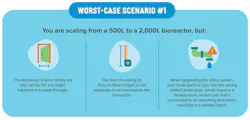
Each of these avoidable challenges means longer shutdowns, higher capital costs, and significant regulatory complexity. In the most extreme cases, such a situation could pose a contamination risk to ongoing operations, resulting in the potential for patient harm.
The solution is to engage an AEC team with a track record of successfully executing a construction project in close proximity to an operational GMP production line. They understand what it takes to deliver one phase of your project today while clearing a pathway to deliver future phases smoothly and with minimal disruption to existing operations.
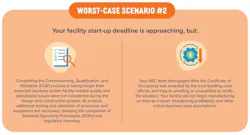
The word “complete” may seem straightforward, but it can mean different things to different people. To an AEC firm—particularly one that’s new to delivering projects for the life sciences—it could simply mean the end of the construction phase, when they leave the building. To a project owner, it may mean the day that commercial manufacturing begins.
Between these two very different definitions lie the important steps of assembling all required documentation and completing the CQV process. A strong AEC partner will integrate these steps into the overall project timeline from day one. They know when to help you initiate the CQV process so that it dovetails with key delivery dates, rather than causing late-stage issues and delays.
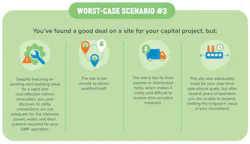
Electing an appropriate site is one of the most significant and far-reaching decisions you will make during your capital project’s lifecycle. To get it right, you need to consider an enormous number of interconnected factors related to the facility, its utility requirements, and the logistics of moving people and raw materials into it while safely moving finished products and waste out.
Lean on your life science AEC team to help you juggle these factors and find the optimal site. They will work with you to define your baseline criteria, assess potential sites against those criteria, and weigh the advantages and trade-offs of each option, ultimately guiding you to a site that ticks every box and will serve you well far into the future.
After project completion
8. How can I get the most from my life science capital investment over the long term?
With so much focus on design and construction, it’s easy to overlook one of the most significant phases of a new facility: the period after project delivery, which—for a well-designed facility built to be flexible and responsive to change—should last decades.
To generate continued value from your facility long after your initial capital investment, it’s important to regularly examine your company’s current relationship to your new asset:
By thinking of your facility not as a static asset but as a dynamic system, and by continuously tweaking, expanding, and optimizing that system, you will generate a greater ROI on your initial investment.
Your AEC team can offer key support in this “post-project” optimization cycle. They understand your facility as intricately as you do and have the tools and strategies you may need to implement and measure improvements.
Conclusion
The right life science construction partner paired with a deep understanding of your business drivers, your manufacturing approach, and a plan for meeting tomorrow’s needs will ensure that you leave the starting blocks with momentum—and that you cross the finish line with a life science operation capable of delivering what patients need today and far into the future.
When you’re ready to get started, let’s talk.
About the Author
CRB
CRB is a leading provider of sustainable engineering, architecture, construction and consulting solutions to the global life sciences and advanced technology industries. Our more than 1,200 employees provide best-in-class solutions that drive success and positive change for our clients, our people and our communities. CRB is a privately held company with a rich 36-year history of serving clients throughout the world, consistently striving for the highest standard of technical knowledge, creativity and execution. Visit our Insights page for more blogs posts. Follow us on LinkedIn and Twitter.