How CRE leaders are navigating policy impacts on construction in 2026

This blog post was authored by Louis Molinini, Americas Lead, Project and Development Services, JLL.
2025 was a year defined by uncertainty throughout the U.S. economy, and the construction industry was no exception. According to research from JLL, U.S. construction spending declined 4.7% in 2025, illustrating the substantial impact of market uncertainty on industry performance.
Fluctuating policy changes, elevated costs for building materials and a tight labor market made forecasting and long-term planning difficult for developers, contractors, and other CRE stakeholders.
Navigating Uncertainty: Construction Costs, Labor, and Market Risks in 2026
Looking ahead, uncertainty will give way to measurable impacts. JLL predicts 0.4% construction spending growth in 2026. This slow pace of growth reflects ongoing industry pressures, especially when it comes to rising costs.
As in-demand sectors and markets see activity return in 2026, others will continue to search for footing. At the same time, trade policy, immigration enforcement and local economic conditions will demand careful assessments of risk and new approaches to mitigating it.
Uncertainty paralysis fades, but cost pressures are rising
Uncertainty and reduced construction demand delayed the impact of trade policies in 2025, while also creating conditions under which cost increases will accelerate alongside activity. As a result, material cost pressures are likely to intensify in 2026.
2025 material prices averaged 4.2% above 2024 prices—however, this reflects a smaller increase than could be attributable to tariffs in the long run. Previously, uncertainty about tariffs incentivized measured responses. Stockpiles of goods afforded some flexibility and limited demand delayed impacts on bid prices.
However, if tariffs remain in place or increase, and construction demand rises, more costs will have to pass through.
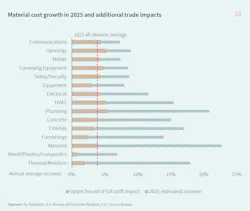
Depending on the material, price increases may range from 5% to 25%. Masonry, plumbing and thermal/moisture materials have the highest upper bounds when it comes to the full impact of tariffs, and based on current policy, JLL estimates an aggregate increase of about 8%.
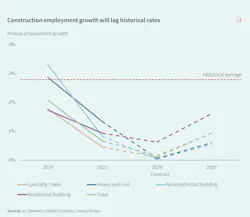
Additionally, current U.S. immigration policy represents a fundamental disruption to the construction labor supply. JLL estimates construction employment growth of 0.2% in 2026, lagging historical rates. As a result, increases in construction activity could lead to labor market bottlenecks that will have lasting negative effects on capacity.
Finally, interest rate reductions, while a positive driver for the industry, do not change the underlying material price escalation or labor challenges caused by trade and immigration policies. Trade and labor costs will compound faster than anticipated interest rate relief, leading to a net increase in costs in 2026.
Development opportunities exist at the local level
As CRE leaders evolve their strategies in 2026, the effects of recent policy changes are more clearly defined than in 2025. And while specific policy implications will vary significantly by region, leaders should keep in mind that the likely outcomes do not favor continued waiting for policy-based cost relief. Instead, success in 2026 will require adopting new approaches to project delivery, risk assessment and supply chain management to account for rapidly evolving conditions on the ground.
Now more than ever, local expertise and engagement are crucial for executing construction projects. Moreover, a deep, granular understanding of local conditions can help business leaders identify opportunities that aren’t immediately apparent under traditional market analysis. Even in markets facing significant impacts from ongoing uncertainty, projects that are well matched to local conditions and risks will maintain development potential. Organizations can manage policy risks while leveraging local expertise and opportunities by embracing early contractor partnerships, flexible risk-sharing arrangements and tailored procurement strategies.
Uncertainty around trade and immigration policy stalled activity in the construction industry in 2025. As the effects of those policies come into focus for 2026, industry stakeholders are contending with elevated material costs and a constrained labor supply. Yet development opportunities still exist, and success will depend on understanding the nuances of local conditions and taking a strategic approach to managing risks rather than waiting for shifts in policy to bring relief.