5 human variables that shape wayfinding in buildings
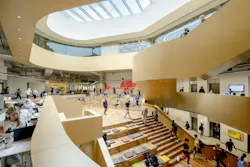
This blog post was authored by Loran Sanvido, Experiential Graphic Designer, CannonDesign; and Chris McCampbell, SEGD, Experiential Graphic Design and Branding Leader, CannonDesign.
When people navigate a building, they aren’t just following signs. They're constantly making sense of the space around them.
When someone enters an unfamiliar environment, their brains immediately start piecing together how the space works so they can figure out where to go. They scan for cues, look for familiarity, and see if the space behaves the way they expect. People want environments to make intuitive sense.
When they don’t, the response becomes emotional rather than logical. Confusion turns into hesitation. Hesitation becomes anxiety. Stress narrows attention and reduces patience. These human responses are variables that can make even simple decisions feel heavy.
That’s when signage often gets used as a bandage for a deeper design problem. But wayfinding works best when it’s built into the space from the start, shaped through planning, sightlines, hierarchy and how places are defined and named. Not added after the architecture is done.
Our Experiential Graphic Design practice operates with the understanding that people don’t want to follow instructions. They want their journey through a building to feel intuitive.
So we design for how people actually find their way. That means focusing on five key factors across three areas: perception and memory, stress and behavior, and human diversity.
Perception and Memory
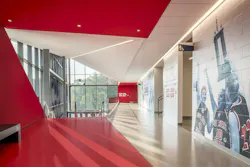
Before anyone reads a word, perception determines whether information is even seen. Contrast, lighting, scale, and visual clutter either support or undermine legibility. If a visitor cannot perceive a visual cue, the system fails before it begins.
Memory then carries the burden. Wayfinding depends heavily on short-term recall—remembering a department name, a floor color, or a turn just taken. Without reinforcement, cognitive load increases and error rates rise.
Design can support this process. Clear visual hierarchy reduces scanning time. Repetition strengthens recall. Landmarks can anchor orientation. Consistent terminology prevents second-guessing.
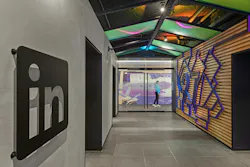
Consider an office environment. A first-time visitor may instinctively look for an information desk because that aligns with prior experience. By emphasizing that desk through lighting, material choice, or brand cues—and by preserving clear sightlines to it—perception is triggered intentionally. The environment confirms expectation rather than contradicting it. When perception and memory are supported, navigation feels effortless.
Stress and Behavior
Navigation rarely happens under calm conditions. In healthcare, visitors often arrive already stressed. In those states, cognition shifts. Stress narrows focus. Patience decreases. People skim rather than read. They gravitate toward what feels obvious or reassuring. Behavior adapts to emotional loads.
Effective wayfinding anticipates this. Clear pathways, distinct decision points, route reinforcement and unmistakable arrival cues reduce ambiguity. In healthcare settings, softer color palettes, intuitive symbols, and reduced text reliance can lower cognitive strain. The goal is behavioral and not merely decorative. It’s about helping people make decisions without overwhelming them. If a system only works when someone is calm, it does not truly work.
Human Diversity
Designing for the “average user” is effectively designing for a narrow slice of humanity. Assuming universal comprehension is design hubris. Human diversity shapes navigation far more than signage alone: language, literacy, age, physical ability, neurodiversity, cultural expectations, and sensory thresholds all influence how people find their way.
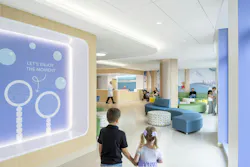
In elementary school environments, wayfinding must support developing independence while accounting for varying abilities, sensory needs, and levels of spatial understanding. Clear landmarks, consistent visual cues, and reduced reliance on text help students make decisions quickly and confidently. By designing for how children actually move, scan, and remember spaces, navigation becomes intuitive, supporting inclusion without instruction.
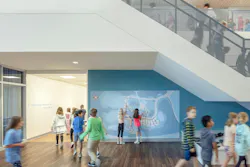
Wayfinding is more than just signage
Wayfinding is not just about direction—it is about care. It is about recognizing that people enter spaces carrying stress, expectation, limitation, and emotion.
Good wayfinding reduces anxiety before it escalates. It restores confidence in moments of uncertainty. It makes people feel considered rather than corrected. When we design for perception, memory, stress, behavior and diversity, we are not simply improving navigation—we are honoring the human experience of space.
About the Author
CannonDesign
CannonDesign’s Insights is a place for the global design firm to share thoughts and news related to their current efforts to help transform businesses, educational models and health paradigms. The firm engages diverse perspectives and expertise to deliver proven, innovative solutions to our most important partners, our clients. Our global network of more than a thousand professionals enable us to create design solutions to the greatest challenges facing our clients and society. Follow us on Facebook, Instagram, LinkedIn, and Twitter.