Data reveals work is changing—adaptive workplaces help you respond
This blog post was authored by Ryan Mullenix, AIA, Partner and Firmwide Corporate Practice Leader, NBBJ.
How work is done today is changing faster than most offices can evolve. Accelerating technology, shifting workflows, and organizational change mean decisions that once unfolded over years now happen in months or even weeks. As a result, companies may be stranded in offices not designed for this level of operational velocity.
At the same time, hybrid work has evolved beyond managing schedules and tasks. Companies now rely on a relationship and innovation-driven economy spurred by collaboration, knowledge exchange, and shared experience—while also wrestling with utilization, cost, and long-term real estate value. However, organizations have something today they lacked before: workplace analytics that capture how people actually work—revealing patterns in interaction, attendance, and space use that were previously invisible.
Analytics reveal what needs to evolve; infrastructure and strategy make it possible to respond, all in real time. Therefore, adaptability can no longer be designed as a secondary feature in the workplace. If incorporated proactively, organizations can support emerging ways of working while protecting the short and long-term value of their real estate investments.
What Does Adaptability Mean In the Workplace?
Adaptability is a means to stay ahead of forces that cannot be fully predicted. Technological advancements, organizational and behavioral shifts, hiring cycles, and demographic constructs will all influence future work styles. But adaptability itself is not a static concept, nor should it be a broadly used single term. The way adaptability shows up in the workplace depends on a company’s priorities, culture, and operating model.
Across organizations, adaptability tends to take one of several distinct forms:
- Change Without Disruption. Office environments designed to remain operational while updates occur, allowing teams to work continuously during reconfiguration. Pre-engineered MEP systems can fit seamlessly into a designed space, ready to support immediate change in use and population.
- Change Through Learning. Workplace pilots used to test layouts, furniture, technology, or collaboration models—generating real-time feedback that informs future decisions. As seen in LinkedIn’s experimental workplaces, insights can be directly incorporated into ongoing changes to reduce design and construction time.
- Change with Speed. Infrastructures that allow rapid reconfiguration as business needs shift—sometimes in days rather than months. Organizations like BlackRock can realign space quickly as business needs shift, leading to greater flexibility not only in workplace but in business unit acquisitions.
- Change Without Waste. Planning and building systems that minimize demolition, rework, and sunk cost by anticipating future scenarios. Brooks Running’s infrastructure walls allow adjacent spaces to evolve over time without major renovations, permitting, or landfill contributions.
- Change Through Agency. Work environments that give teams control over how space is used—through movable elements, adjustable settings, and flexible layouts. Entertainment, gaming, or product design organization with diverse team needs can enable a framework for personalization without tedious real estate oversight.
The New Definition of Success in Workplace Design Change
Success is no longer benchmarked by how completely a design vision is realized on Day One, but by how effectively it performs as conditions evolve. Today, successful change can be defined by four characteristics:
- It is measurable
- It causes minimal operational disruption
- It reduces recurring cost and effort over time
- It simplifies future decision-making rather than complicating it
When these conditions are met, change becomes less painful and often more encouraged. Follow-on adjustments decrease, friction diminishes, and the workplace begins to support teams intuitively.
Workplace Design Change in Action
LinkedIn: Change Driven by Analytics
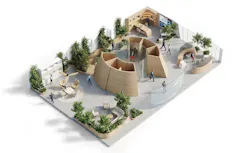
Analytics can shift workplace change from reactive to predictive. Following COVID and evolving hybrid expectations, LinkedIn sought to understand not just attendance, but how work was happening—where collaboration forms, what influences presence, and how space supports relationships, including at its global headquarters. To do this, LinkedIn built an internal workplace analytics capability that moved from basic measurement to predictive decision-making, integrating attendance data, behavioral insights, spatial utilization, and collaboration indicators.
Patterns quickly emerged. Attendance varied by team proximity and leadership presence, commute friction influenced participation, and market-specific conditions—even environmental factors like dew point—shifted behavior. These insights allowed LinkedIn to move beyond assumptions about how work should happen and instead design environments that respond to how it truly does.
BlackRock: Change Powered by Speed
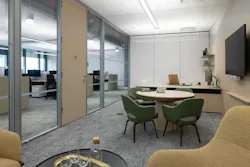
When infrastructure is designed to flex, organizations can reconfigure at the pace of business. BlackRock required a workplace that could respond to organizational change without downtime, major capital reinvestment, or operational disruption.
By incorporating flexible infrastructure such as raised floors, underfloor air and power, wireless lighting and demountable partitions, BlackRock’s workplace supports rapid re-stacking and team reconfiguration. In practice, this enables large portions of the workforce to be reorganized—in some cases, over a single weekend—at a fraction of the cost typically associated with traditional renovation or relocation.
This capability allows BlackRock to respond to real-time business needs rather than forecast years ahead, aligning space more closely with demand while preserving long-term real estate value.
Brooks Running: Change Enabled by Infrastructure
Intentionally placed systems allow the workplace to evolve without rebuilding. As Brooks Running nearly doubled in size while working across disparate buildings, the company needed a workplace that could grow and reorganize without costly or disruptive interventions.
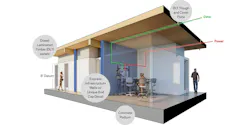
NBBJ and Brooks implemented infrastructure walls—fixed zones that consolidate power, data, and mechanical systems—creating a stable backbone around which surrounding spaces could evolve. Paired with Day-1 and Day-2 planning and differentiated programs across buildings, this approach allowed Brooks to test and refine workplace strategies over time—using operational feedback and performance data to guide future adjustments rather than relying solely on upfront projections.
With core systems locked in place, adjacent spaces can shift quickly to support workstation growth, collaboration zones, research functions, and large gatherings without demolition or rewiring. Today, Brooks’ workplace flexes by roughly 50% capacity with minimal disruption, allowing the organization to align space changes to actual demand rather than projected need.
How Organizations Can Apply This Thinking to Their Own Workplaces
Adaptability is not about designing endlessly flexible spaces. It is about designing systems that make future decisions easier. Rather than framing adaptability as reactive versus predictive, many organizations find it more useful to think in terms of progression—building capability over time.
A simplified approach includes three steps:
- Define the Goal. Why is change being made, and what outcome should be different on the other side? Without clarity here, even well-executed change creates friction.
- Establish What Can be Measured. Utilization patterns, collaboration frequency, space turnover, and service demand indicators all provide signals that help organizations understand whether space is working as intended.
- Adapt Based on Evidence. The most effective interventions are those that create future optionality, reducing the cost of change and accelerating the speed of responses when conditions shift again.
Technology, talent mobility, and workflow patterns are quickly outpacing traditional real estate cycles. The organizations that will thrive are not those that attempt to plan perfectly, but those that build environments capable of evolving with clarity, speed, and minimal disruption.
The future of work does not need to be predicted; it needs to be enabled. I’m reminded by the fitting words of Abundance co-author Derek Thompson: “Growth is good. Change is hard. Both are true. And stasis sucks.”
Organizations can’t prioritize growth without change or change without growth; just as importantly, they also can’t remain idle. The workplace can support all three—when strategy, analytics, and infrastructure align, organizations can respond to insights in real time. The workplace becomes not a fixed environment defined on opening day, but a system designed to evolve as work itself continues to change.
About the Author
NBBJ
NBBJ creates innovative places and experiences for organizations worldwide, and designs environments, communities, and buildings that enhance people’s lives. Founded in 1943, NBBJ is an industry leader in healthcare and corporate facilities and has a strong presence in the commercial, civic, science, education and sports markets. To view all of NBBJ’s ideas, visit our website or follow us on Facebook, LinkedIn, Twitter