Measuring office sound: 6 findings for creating acoustic balance in the modern workplace

In workplace acoustics, reducing noise and prioritizing quiet focus has remained the default goal for organizations looking to foster a productive work environment. But, as new generations enter the workforce and hybrid models become more common, expectations are shifting. Today, there’s a growing demand for offices that feel more social, vibrant, and collaborative.
In hybrid models where employees may only be in the office one or two days a week, many are using that time in-person to collaborate in ways they aren’t able to when remote. Hybrid work has also contributed to increased virtual meeting fatigue. A recent Johns Hopkins University study found that 51% of Gen Z employees now prefer face-to-face communication and want to use time in the office to socially engage.
As a result, noise preferences in the office are becoming more individualized—and more complex. While a social and buzzy environment may work well for one employee, it can be distracting for another. This raises an important question for designers: What should an office actually sound like? Is it possible to create a workplace that feels lively and social without disrupting focus?
A typical office day, especially in open-plan layouts, already include footsteps, keyboard clicks, phone calls, and in-person conversations layered over HVAC hum. The issue isn’t whether sound exists, but how much, and what kind, supports collective performance. When considering how to foster a collectively productive workplace, acoustic strategy becomes central to balancing “lively” and “distracting” while ensuring all employees feel supported.
To better understand this balance, acoustic design must move beyond intuition and into measurement.
Study: Measuring the Modern Workplace Soundscape
A recent site observation from HLW’s Ark Research Lab evaluated how “alive” a Raleigh-based client’s office felt. In this observation, decibel levels were measured and sound conditions were recorded across 10 floors at multiple times throughout the day.
The research aimed to determine whether collaboration and concentration can meaningfully coexist and how sound levels shape that relationship. By analyzing acoustic patterns across different work zones, the team sought to identify measurable benchmarks for creating workplaces that support both activity and focus.
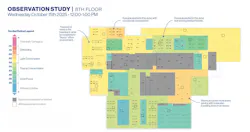
6 Key Findings on Office Sound (and What Designers Can Take Away)
From the study, the Ark research team came across six key findings about the impact of office sound on productivity and comfort:
1. 55 dB Is Where Vibrancy Begins
The sound of the HVAC system is drowned out by voices, keyboard clatter, and papers shuffling. An occasional loud laugh or door closing spikes the recording to roughly 70 dB, but staff can still easily focus and an active energy is present in the space.
For designers, this suggests that moderate background activity can help a workplace feel socially engaged without necessarily disrupting productivity. The key is to ensure some peaks and valleys in the noise levels but within a range that is not too loud or too quiet.
2. There’s Focus, and Then There’s Deep Focus
While sustained work was easily supported in spaces averaging 50 dB, a distinct cognitive shift occurred in rooms measuring closer to 30–35 dB. Research suggests that in these quieter environments, the brain expends less effort filtering background noise, enabling deeper concentration.
Providing spaces within this quieter range can support tasks requiring extended focus.
3. Acoustic Ceiling Tiles Make a Measurable Difference
Zones outfitted with acoustic ceiling tiles were consistently 10–20 dB quieter than areas with exposed ceilings. This difference effectively created natural focus zones within open floor plans.
Designers can use ceiling systems strategically to establish acoustic gradients across the workplace without dramatically altering layout.
4. HVAC Sets the Baseline for Quiet
In quieter areas, the HVAC poses as the loudest sound and sets a baseline of about 45 dB in most spaces, which is an appropriate level for typical concentration.
Maintaining a consistent mechanical background may actually help mask intermittent disruptions elsewhere in the office. This sound, however, does not contribute to the feeling of vibrancy as our minds effectively filter out these consistent hums.
5. Density Doesn’t Always Equal Noise
Several open work areas with six to eight occupants maintained sound levels around 45 dB when acoustic desk barriers were present and phone use was minimal, challenging the assumption that more people automatically create louder environments.
Instead, acoustic treatments and behavioral patterns can significantly influence overall sound levels.
6. Too Quiet Can Feel Uncomfortable
While not observed during this study, existing research indicates that sound levels below 10 dB can feel unsettling or even anxiety-inducing for some individuals.
This underscores an important point: the goal isn’t absolute silence, but an appropriate acoustic range that supports different types of work.

Acoustic Design Strategies for Accommodating Varying Office Needs
Each of these findings provides valuable direction for designers, highlighting several strategies that can help address key acoustic challenges in the workplace.
Managing Acoustic Spikes in the Workplace
One of the most important takeaways is the role of sudden acoustic spikes. This research suggests that distracting noise is often driven less by steady background hum and more by high-amplitude peaks—sudden bursts of sound that linger or echo.
A consistent HVAC baseline (between 40 and 50 dB) may be less disruptive than intermittent spikes that require cognitive filtering. Managing these peaks becomes central to balancing collaboration and concentration.
Optimal Office Sound Levels for Collaboration and Focus
To address this strategic zoning and creating a range of sound environments, such as “buzz” and “focus” zones helps to make each space feel more effective by contrast. In open offices, the target range for overall sound is 40–60 dB.
This allows enough ambient noise so people feel comfortable talking and taking calls. In this zone, peaks and valleys can blend more seamlessly with the HVAC hum, creating a truly buzzy environment. In focus areas, the target is 20–30 dB for deep work. A deep quiet feels more impactful after experiencing a lively open office.
Prioritizing dampening HVAC noise at its source with diffusers helps to create headroom for productive noise.
Controlling Reverberation Time Through Design
Managing Reverberation Time (RT) also plays a key role in reducing peaks and creating a more acoustically balanced environment. RT refers to the time it takes for sound to decay within a space.
When properly calibrated, sound dissipates quickly rather than bouncing across hard surfaces. Material selection and spatial geometry both influence RT. Curved walls, wood surfaces, suspended baffles, and varied surface treatments disperse sound waves more effectively than flat, reflective planes.
These elements help reduce echo and soften sharp peaks while maintaining a comfortable ambient buzz.
Creating a More Acoustically Balanced Workplace
The future workplace may not be defined by open versus enclosed layouts, but rather by its acoustic range. Instead of debating whether offices should be loud or quiet, leaders may need to ask: Are we providing the right acoustic conditions for the task at hand? Office sound is not abstract nor uncontrollable.
It is measurable, studyable, and ultimately designable. Through strategic zoning, thoughtfully specified ceiling systems, clearly communicated behavioral norms, and well-calibrated mechanical baselines, organizations can create environments where collaboration and concentration coexist. The goal is not silence but alignment between the task, the environment, and employee needs.