The future of student housing lies in shared living—and shared meals
This blog post was authored by Brendan Connolly, FAIA, LEED AP, Partner, Mithun.
Universities are facing progressive challenges in the effort to offer affordable access to higher education for new generations of students. Housing affordability stands out as a fundamental obstacle given dramatic increases in the cost of both on- and off-campus housing, leaving many students without options to pursue their educational goals.
Escalating rental rates are particularly amplified in urban areas where housing stock is limited and in high demand. Urban housing pressure is being felt locally at campuses like the University of Washington and Seattle University, and it’s driving campus and urban planning across the nation.
UCLA is a prime example of the student housing affordability crisis, and also the potential for innovation. Median rents in the Westwood area of Los Angeles rose dramatically in the last decade, with the average rent for a three-bedroom unit currently $8250—55% higher than it was three years ago.
How Urban Universities Are Addressing Student Housing Costs in High-Demand Markets
Like many universities, UCLA has been forced to address this problem head-on with novel solutions. To fulfill their housing guarantee, UCLA has created more than 4,500 new student beds in the last decade, a significant increase in overall campus housing capacity but still at price points that remain out of reach for many students.
To meet the highest tier of economic need at UCLA and other similar institutions of higher education, a new affordable campus housing solution and approach is needed.
A new approach to a growing need
With only 400 acres and more than 47,000 undergraduate and graduate students, UCLA is the most dense University of California campus and one of the most urban universities in the country. Space on campus is limited for new expansion possibilities. So, increasingly, the university, like many institutions, looks to its campus-edge urban fabric to meet needed housing capacities.
Gayley Towers, a new affordable co-housing project under construction across the street from campus, is one such project prototype. Gayley Towers will deliver 585 student beds in an experimental new cooperative housing model that is based on shared meals and vertically integrated student community clusters.
Shared Kitchens and Co-Living: A New Model for Student Housing Affordability in California
At its core purpose, this “first of” co-housing project was envisioned to bridge the gap for the highest-need students, creating rent structures as low as $600/month to allow students access to quality and affordable housing that is commensurate in quality with all campus housing offerings.
No dead ends
To do this, the project needed to be highly efficient in organization and utilization of its tight urban site.
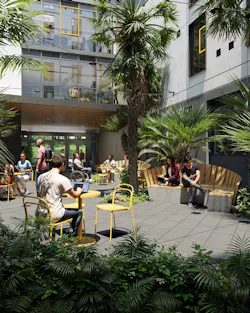
Gayley Towers is organized to optimize a mid-rise construction limit with eight stories organized around a ringed circulation system that encloses an open-air courtyard.
This approach not only yields the greatest number of beds, it also affords protection and respite for students from urban noise and activity.
The courtyard oasis provides daylight access to units and a key opportunity to connect students with nature in an urban environment.
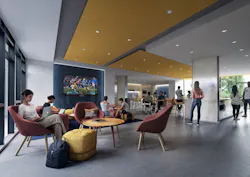
The continuous circulation path minimizes needed stairs and avoids dead ends, so that no students are isolated at the end of long, linear corridors. This connected circuit of movement ties back at each floor to a study commons and kitchen area—the key communal program block that unites students through gathering and food.
Food as foundation
Food is fundamental to student success. According to recent reports by the U.S. Government Accountability Office, roughly 3.8 million or 23% of college students experienced food insecurity in 2020, a condition that has arguably worsened since then due to more recent economic strain.
These issues are coupled with other elements of depression, anxiety and academic stress, requiring a careful approach to creating a sense of belonging and support for diverse students.
After significant outreach and exploration of program options, Gayley Towers adopted a unique co-housing, shared food preparation strategy to create social cohesion and support.
By gathering each floor of 75 students in a food-making tradition in a shared space, this model will help to overcome food insecurity by allowing students the choice to bypass traditional meal plans and bond with other students through food preparation and gathering. Each floor contains three distinct cooking stations, and each residential unit is designed with extra space to accommodate personal secure food storage.
Nourishing blended economic and emotional needs
The union of housing affordability and shared food preparation is also at the center of another unique campus housing project at UC San Diego that explored co-housing in a different context.
UC San Diego’s Nuevo West is a unique blended housing precinct that unites graduate and professional students with a non-profit housing assistance program called the La Jolla Family House that provides short- and medium-term housing for families in need who are caring for loved ones undergoing cancer treatments at neighboring UCSD medical facilities.
At the center of this blended user mix is a shared kitchen that serves as a community fulcrum for the program. Families experiencing trauma with their loved ones participate in food preparation with students and volunteer groups who converge to help prepare meals. This nexus of shared food creates community cohesion, enables healing for families and fosters empathy among medical and professional students who engage in real-time connections with the families and patients they serve.
The model for this community kitchen parallels the Gayley Tower idea, with multiple cooking platforms, flexible preparation space and securable food storage to enable comfort and security for all users while catalyzing community building.
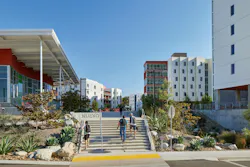
Nuevo West creates a new gateway at the UC San Diego campus edge, and this symbolic and real blending of users with emotional and economic need is a fitting reflection of the complex roles that universities play in our world. As pressures mount across the nation to sustain institutions of higher learning against economic and political forces, innovative affordable housing solutions like Nuevo West and Gayley Towers provide insight into new ways that campuses are addressing their futures.
By thinking vertically and combining diverse users, and centering the human experience around protected shared spaces and communion through food, these solutions transcend simple equations of bed count to create new relevance and impact on campus. Together, they highlight the exciting potential of more meaningful investment in residential space and resources to address affordability and well-being through adaptable and inclusive thinking on campus, and throughout our cities.
About the Author
Mithun
Mithun is an integrated design firm dedicated to creating positive change in people’s lives. We are an internationally recognized leader in sustainability, combining exemplary design with a focus on building and site performance, human health, and social equity. A national practice with offices in Seattle, San Francisco, and Los Angeles, our interdisciplinary team works in a wide range of typologies and scales—with a focus on urban environments and places where people live, work, learn, and connect. Follow Mithun on LinkedIn and Instagram.