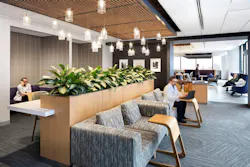
The staff lounge is getting some serious upgrades
This blog post was authored by Samantha Belfoure, NCIDQ, LEED AP, Associate Principal, Perkins Eastman.
The senior living industry is growing today more than ever, and the architecture and design industry has responded with heavy emphasis on innovations for these incoming residents.
While this is exciting to see how ideas are evolving, we need to be asking ourselves a bigger question: What are we doing to put a similar focus on the caregivers and staff that are ultimately the backbone of our communities?
The senior housing sector, along with hospitals and educational institutions at all levels, is still suffering dramatic, pandemic-triggered staffing shortages nationwide. Though there are many factors behind the problem, one looms large: these sectors share a front-line workforce that had to keep working while everyone else stayed home. Traditionally designed facilities weren’t offering the kind of spaces that workers needed to seek respite and renewal.
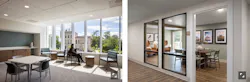
With these conditions as a backdrop, our practice partnered with Perkins Eastman’s Human Centered Consulting Group, co-led by Senior Associate Emily Chmielewski, to look more deeply into how workspace design can improve staff retention. Our inquiry resulted in Changing Perspective: Transforming Work Spaces in Senior Living, which looks to other practice areas to inform how senior housing design can be more intentional for all its occupants, not just the paying residents.
We explored these issues against a decidedly poor status quo: senior living communities where a break room had staff competing for a single computer for online training while others were stepping around them to heat up their lunch. Elsewhere, those who needed to take private phone calls either had to go out to their cars or step into the custodial closet. Such stories led us to question: “Is the hierarchy of focusing architecture and design on the experience of the resident (and then administration, with care team members coming last) outdated? … If the experience of the resident is primary, the people caring for residents must be equally important.”
We didn’t have to look far to see how our colleagues are handling similar situations.
Healthcare
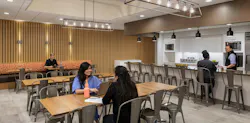
“We were always concerned about staff,” says Principal Jason Haim, referring to the airy and open spaces made available to them at MarinHealth Medical Center in Greenbrae, Calif. When he led the team that designed the new hospital prior to its opening in 2020, Haim says, “we refused to allow staff spaces to be closets and afterthoughts.” Staff lounges can be found in each department, for example, rather than a central location that makes everyone travel, and each has ample space, windows, and natural light.
Perkins Eastman Principal Joanne Violanti followed the same imperative in New York when she worked, respectively, on the David H. Koch Center for Cancer Care at Memorial Sloan Kettering Cancer Center and the Memorial Sloan Kettering Josie Robertson Surgery Center. Each facility offers staff—at all levels—richly appointed lounges, work rooms, and dining areas. “They realized it was an important tool for recruitment and retention.”
Higher Education
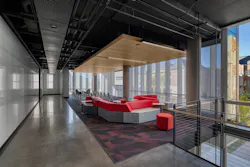
When we looked to educational settings such as James M. McKelvey, Sr. Hall at Washington University in St. Louis, Mo., they found that its computer science and engineering professors and researchers were yearning for more congregation and collaboration in the new building.
In their previous building, “the spaces were monastic and isolating,” says Senior Associate Jennifer Romeo, one of the project’s lead architects. McKelvey Hall is organized in an L shape, with a central, open stair at the intersection of the two wings that arrives at a large, flexible common space on each floor.
“It was meant as a nexus for people to come together who might not typically do so from day to day,” Romeo says.
K-12 Education
Professional development is also a major issue for staff working in K-12 schools, not to mention quality collaboration outside of the classroom and dedicated space for rest and wellness. Historically—particularly in public schools—teachers and staff would have to borrow a classroom for a conference or presentation, and their break room might be relegated to a central, windowless room.
Even with constrained budgets, the K-12 practice tries to create spaces with natural light and multiple zones to serve various needs.
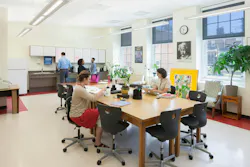
“Even when it’s small, it can be good. We just have to get creative,” says Ann Neeriemer, an associate principal in Raleigh. A single room can have a softer feel on one side with seating and plants, and built-in storage systems, a kitchen counter, and small tables can be located on the other wall, while flexible worktables form a bridge between the zones.
Whatever the space presents, Neeriemer adds, “we need to make sure they have all the resources they need.”
About the Author
Perkins Eastman
Perkins Eastman is a network of more than 1,100 thinkers, dreamers, and doers dedicated to the human experience. While our practice spans sixty countries across five continents, each project is distinctly local—a dynamic structure, space, or solution for people to live, learn, work, play, and heal. Our blog, Insights, is proud to cover the design and innovation that is constantly emerging from our eighteen practice areas and twenty-four interdisciplinary studios worldwide. Find us on LinkedIn, Instagram, Twitter, and Vimeo.