Addressing the senior housing shortage demands an evolved approach
This blog post was authored by Jeremy Southerland, LEED AP, Fitwel Ambassador, Associate Principal, Perkins Eastman.
The entire baby boom generation will be 65 or older by 2030, but as we’ve watched this generation’s march into retirement and beyond for many years now, the housing industry is still falling short. Senior housing construction starts recorded an all-time low in the first quarter of 2025, according to NAIOP, with just 1,287 new starts compared to a high of more than 12,000 in the first quarter of 2018. Post-pandemic staffing shortages, high inflation, and high interest rates are among the causes for this lopsided supply vs. demand.
Active-adult developments and communities offer a promising solution for developers and older adults, because it decouples housing from services. Unlike independent living, which typically includes meal services, active adult is a stand-alone residential offering. Active-adult communities that have been open at least two years have occupancy rates close to 96 percent, according to a fall report by the National Investment Center for Seniors Housing & Care, yet they accommodate just 0.5% of Americans ages 65 to 84, the NAIOP report said.
A Shift To Self Advocacy
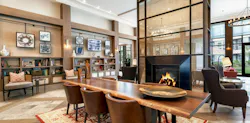
Active adult properties appeal to baby boomers and older Gen Xers whose focus on health and wellness is delaying the need for care-based communities. The decision to move is primarily a lifestyle choice for those with the means to afford resort-style amenities in central urban locations. Canvas Valley Forge in suburban Philadelphia is one example. Its rich finishes and furnishings, in addition to numerous amenities, are nearly indistinguishable from luxury market-rate multifamily developments.
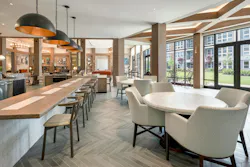
Affordable developments appeal to seniors who want to remain in their local communities even as real estate prices have soared. La Mora Senior Apartments in Yonkers, NY, and Northaven West in Seattle are reserved for seniors within predetermined income ranges. Their lack of bundled services such as meals and healthcare eliminates the hefty monthly service fees associated with independent living and higher-acuity care environments.
Both market-rate and affordable properties offer a turnkey lifestyle for those who no longer want the space, maintenance, or expense of a single-family home. If this model is to be a viable alternative to independent living, however, successful developments will have outside services located nearby or, in some cases, within the same building.
Proximity to healthcare services and facilities is important, but lifestyle amenities are the real motivators for this generation of seniors. They want all the aspects of an active life to be within walking distance: restaurants, coffee shops, pharmacies, grocery stores, opportunities for learning, and places for social engagement. Easy access to nature and spaces for exercise and wellness are also major attractions.
Designing a Lifestyle for Aging
We believe the key to creating environments for active aging lies in the convergence of our senior living, residential, and hospitality practice expertise.
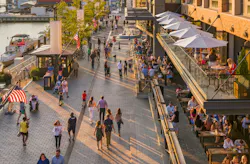
Imagine a vibrant mixed-use setting like The Wharf in Washington, D.C., with its dining, walkability, and multigenerational energy, serving as the everyday backdrop for older adults who want connection, convenience, and choice.
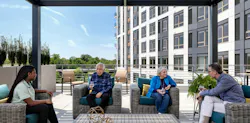
Now consider a suburban example: Revelle of King of Prussia, located directly within the King of Prussia Town Center near Philadelphia. By placing older-adult housing steps from retail, dining, entertainment, and public gathering spaces, the development demonstrates how siting within a lifestyle-rich district can support independence without requiring large internal amenities.
Imagine, too, the adaptability of apartments like those designed for Western Supply in Tulsa, Okla., where flexible space is integrated into each residence for use as an office, studio, fitness area, or quiet retreat, supporting the evolving ways people live, work, and stay active.
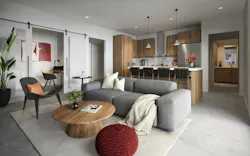
Together, these ideas illustrate how active adult communities can thrive: by leveraging the lifestyle infrastructure of mixed-use environments and combining it with the flexibility and familiarity of multifamily living.
An Opportunity for Partnership
The senior housing shortage makes the emerging active adult space ripe for multifamily developers. The lack of healthcare and meal services enables a staffing model nearly comparable to a standard market-rate multifamily product. For existing senior living providers, active adult offers a new entry point for residents into the continuum of care—an operationally low-impact growth opportunity that can yield creative partnerships with multifamily developers. These endeavors also leave room for a new business model to emerge: independent service providers that co-locate and work in tandem with active-adult properties.
Given the robust demand for active adult housing, the future of senior living will continue to trend toward mixed-use developments and districts rather than self-contained islands where every type of service and care is offered in-house. It’s time to start thinking about how our existing communities can best support older adults and enrich their lives through developer-provider partnerships, adaptable designs, and intergenerational exchange.
About the Author
Perkins Eastman
Perkins Eastman is a network of more than 1,100 thinkers, dreamers, and doers dedicated to the human experience. While our practice spans sixty countries across five continents, each project is distinctly local—a dynamic structure, space, or solution for people to live, learn, work, play, and heal. Our blog, Insights, is proud to cover the design and innovation that is constantly emerging from our eighteen practice areas and twenty-four interdisciplinary studios worldwide. Find us on LinkedIn, Instagram, Twitter, and Vimeo.