How human-centered design is reshaping laboratory safety
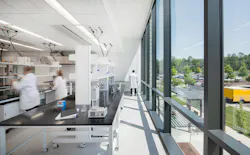
The primary goal for today’s laboratory planners is to create an environment that is safe, inviting, and free of stressors by addressing risks at their source.
Effective laboratory design begins with understanding people and their workflows, regulatory compliance, hazard and risk profiles, safety controls, and separation strategies.
By designing clear and intuitive pathways, lab planners can reduce cognitive load, mitigate physical crowding, minimize human error, and discourage unsafe workarounds.
Human-Centered Lab Design Starts with Safety, Workflow, and Risk-Informed Planning
Beyond safety, well-designed laboratories enhance workers’ knowledge, engagement, and satisfaction, which directly support the recruitment and long-term retention of skilled staff.
Safety is the foundation for human-centered design
Every well-functioning lab begins with a clear understanding of its purpose, workflows, and hazard profile. Built from the Safety Data Sheets (SDS) for materials in use, the hazard profile translates a lab’s chemical inventory into concrete design requirements, including ventilation rates, control area boundaries, occupancy classifications, structural ratings, and storage strategies. The hazard profile is one tool used to guide the safe and effective design of a healthy lab. Completing it during programming or schematic design is the critical first step. A design decision that takes an hour to resolve in schematic design can take weeks and require a significant budget to correct in construction documents.
The hazard profile’s reach extends beyond code compliance. A lab’s chemical inventory determines whether a space falls under a business (B) or high hazard (H) occupancy classification, which cascades into construction type, fire-resistance ratings, and egress configuration. A concentration of flammable solvents shapes ventilation design, affecting emergency response and the air quality researchers breathe. Users feel the effects of these invisible infrastructure decisions daily. With this complexity spanning structures, systems, and safety, the lab planning team’s cumulative experience becomes essential.
In some cases, particularly within multi-tenant research facilities, projects begin without a clearly defined use. When there is insufficient information to develop a hazard profile, the most effective approach is to create a flexible, modular infrastructure that evolves alongside changing occupants and research programs. In all scenarios, the objective remains the same: to design a lab environment that supports researchers without constraining them.
Success is achieved when safety systems are so thoroughly integrated that they operate seamlessly in the background, requiring no conscious attention from the people they protect.
Design as engineer controls
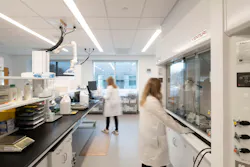
According to OSHA's hierarchy of controls, engineered solutions are preferable to behavioral interventions because they isolate hazards without relying on human behavior. When reach ranges, acoustic conditions, circulation paths, and equipment placement are resolved in the design, they eliminate the conditions that lead to unsafe workarounds.
A common example is chemical reach. A standard high-performance liquid chromatography (HPLC) stack stores solvents at the top. When placed on a standard bench, researchers are often forced to reach above shoulder height to access hazardous materials. That reach requirement creates a potential spill hazard every time those solvents are needed. Dropping the bench to 30 inches or lower brings the work into the researcher's functional reach zone, allowing the ergonomic solution to eliminate the hazard at the source. Limiting overhead shelving and keeping materials within approximately 15 inches of reach reduces exposure risks and the likelihood that researchers will improvise storage arrangements that undermine the original layout.
Acoustic zoning addresses a different category of cognitive and safety risk. Minus eighty freezers and fume hoods generate significant noise. Locating them adjacent to analytical workstations or data review areas forces lab staff to work in conditions that research suggests increase error rates and mental fatigue. Positioning noise-generating equipment in a designated utilitarian zone, away from primary work surfaces, incurs no schematic design cost and is difficult to correct after construction.
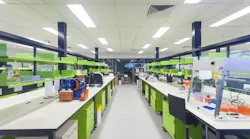
Circulation and safety station placement follow the same principle of standardization. Placing emergency eyewashes and safety showers consistently at lab entries, adjacent to hand-wash sinks, and along the path of egress ensures that any researcher entering any lab in the building can locate safety equipment without orienting to a new layout. Fume hoods are best positioned at the far end of the lab from the entry, creating a gradient from lower to higher hazard that aligns with natural circulation patterns and reduces the likelihood of an egress path running through the highest-risk zone.
Engineered controls reduce human behavior as a safety variable, but there are limits. ANSI/ASSP Z9.5-2022 establishes how a ventilation system must perform, while acknowledging that routine occupant activity creates real-world variation. A human-centered design approach accounts for those realities before they become performance failures.
Workflow and wayfinding: Designing labs that reduce mental overload
A lab that requires conscious effort to navigate competes with the work conducted in it. When spatial organization follows the logic of how research moves, researchers subconsciously build mental maps, preserving cognitive availability for their work. Predictable, navigable spaces reduce cognitive load in the workplace.
In one lab optimization project, the first step was to separate the laboratory from the office area, creating additional perimeter space for HPLC equipment. Using workflow-based zoning as a primary strategy, a 5S assessment (sort, set in order, shine, standardize, and sustain) revealed that equipment had been placed wherever bench space was available, regardless of process sequence. Relocating and consolidating HPLCs along the perimeter freed up valuable bench space, supporting a more efficient, uninterrupted workflow. Additional improvements, such as reorganizing storage and establishing dedicated kit drop-off areas aligned with workflow, resulted in an internally measured 8% increase in annual productivity.
Natural light and visual connections to adjacent spaces support orientation and reduce the ambient stress of working in an interior environment. In one facility, adding daylight and sightlines to a previously windowless lab transformed user experience, according to researchers.
Incorporating EHS early to align science, safety, and budget
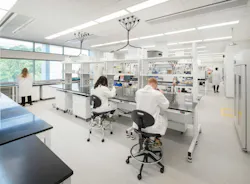
Environmental health and safety (EHS) professionals belong at the design table from day one. Unfortunately, EHS input often arrives after critical decisions are already locked in, creating expensive problems that early collaboration would have prevented. Every organization maintains specific safety requirements and operational protocols that exceed code minimums. Common examples include internal standards regarding hood face velocity, eyewash placement rules, and chemical storage protocols. EHS is the authoritative source for translating internal requirements into design criteria during programming and schematic design.
EHS professionals also know what other labs and potential hazards are within the same control area as the new lab. A new lab with a modest flammable inventory might push the control area over its International Building Code (IBC) maximum allowable quantity (MAQ) threshold if the existing labs already consume a significant portion of the flammable allowance. Exceeding the MAQ limit triggers occupancy reclassification, new fire-rated barriers, and potentially reconfigured mechanical systems, issues best addressed in the design phase. EHS holds the institutional chemical inventory data that enables this analysis. Without it, the design team is working against an incomplete picture.
Safety designs that increase lab value
Designing a safe lab is a baseline expectation. The more elevated approach questions how safety design supports or inhibits researchers in doing their best work. Integrating the human factor and workflow optimization into safety design from the project’s start enables organizations to build labs where people can thrive.
Labs with well-designed safety infrastructure become strategic organizational assets. These labs can pay dividends through increased researcher satisfaction, reduced researcher turnover, and fewer unsafe workarounds. In competitive fields where talent recruitment and retention determine success, laboratories designed for how people work are differentiators that can attract top researchers and support long-term innovation. Design choices that remove stressors, reduce cognitive burden, and create spaces where scientists can focus their mental energy on discovery provide the conditions that extract maximum value from the facility investment and the talented people who work there.
About the Author:
George Kemper is the laboratory planning director for Hanbury. Hanbury is a 100% employee-owned, multidisciplinary design practice founded in 1979, specializing in architecture, planning, and interior design across the higher education, life science, and civic and community markets. Over more than four decades, the firm has grown into a recognized industry leader with a diverse team of experts across multiple offices who approach every project through partnership and shared vision, aligning design with the global impact of clients' work to address critical issues and enhance community well-being. For more information, please visit www.hanbury.design.