4,500 hours a year: The hidden cost of poor wayfinding in healthcare
This blog post was authored by Kirsten Miller, AIA, ACHA, EDAC, Associate and Medical Planner, GBBN.
Research shows that patients spend nearly 30% of their total medical care time traveling—an average of 38 minutes per visit. That time is often spent navigating sprawling medical campuses, not receiving care.
For large, urban, and often landlocked hospitals, improving the arrival and wayfinding experience is no longer a “nice to have.” It is central to patient satisfaction and staff efficiency. Beyond time saved, efficiency, and anxiety reduction, intuitive wayfinding restores patient agency.
Today’s patients have choices. Feeling welcome, safe, and confident to navigate independently to an appointment plays a meaningful role in whether they return. While help may always be available from staff, being able to self-navigate instills dignity, especially for first-time patients, people in distress, neurodivergent users, or anyone already feeling vulnerable.
When wayfinding is intuitive, it implies, “you are capable, we trust you.”
Why Hospital Wayfinding Is Critical to Patient Experience
As healthcare campuses add security measures and continue to evolve, intuitive wayfinding has become one of the most powerful tools for improving the patient experience. Architecture plays a direct role in reducing these inefficiencies.
Clear public circulation, visible destinations, and intuitive spatial cues can streamline the patient journey while freeing staff to focus on care rather than directions.
The cost of poor wayfinding
When hospitals function like mazes, patients are more likely to arrive late, feel stressed before their appointments, and leave with a negative impression that has nothing to do with clinical care. Staff feel the impact as well.
Studies estimate that poor wayfinding can cost hospitals up to 4,500 staff hours per year as employees stop to redirect lost patients and families.
Why large hospitals are hard to navigate
Large hospitals are rarely designed all at once. They grow over decades through additions and renovations, often resulting in unclear circulation, competing entry points, and confusing routes. Research led by GBBN’s Director of Research, Dr. Shan Jiang and Dr. Hui Cai, a professor at the Georgia Institute of Technology, highlights how campus configuration and building approach directly influence patient arrival, orientation, and navigation.
When circulation becomes fragmented, anxiety increases—for patients and for the staff who are repeatedly pulled away from their work to give directions.
Healthcare is a consumer industry, and most routine care now happens closer to where patients live. But when people need the specialized services only a major medical center can provide, the experience must begin with a clear, welcoming “front door.” That front door should be easy to find, easy to understand, and designed to empower patients from the moment they arrive.
Designing the journey, not just the building
The patient experience should be considered as a continuous journey—from arriving on campus to reaching their destination. Along the way, patients may need to visit registration, labs, imaging, or security checkpoints. Each transition is an opportunity either to reduce anxiety or compound it.
Wider Spaces
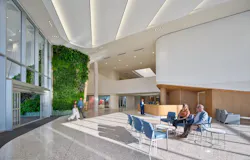
Generous public corridors are one of the simplest and most effective tools for intuitive navigation. Wider spaces allow patients and families the time and room to read signage, recognize landmarks, and orient themselves without feeling rushed or in the way.
At TriHealth’s Bethesda North Hospital in Cincinnati, Ohio, public circulation spaces reach up to 30 feet wide, transitioning into corridors that vary between 11 and 20 feet. This allows groups to pass comfortably and helps patients identify visual cues—such as color, materials, or light—that naturally draw them toward key destinations.
Widths were determined based on the amount of foot traffic in the area and the existing infrastructure. Pause points were incorporated in the design—like placing a bench along a sidewalk.
Reducing Visual Clutter
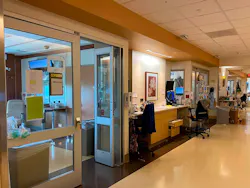
Equally important is reducing visual clutter. Items like wheelchairs, hand sanitizer stations, and PPE are essential, but when they overwhelm corridors, they distract from wayfinding because visual clutter increases the cognitive burden on people as they navigate the space.
Thoughtful integration makes these elements accessible without competing for attention. At UK Healthcare in Lexington, Ky., a renovated ICU corridor on the 12th floor of the Albert B. Chandler Hospital uses a modular system to organize PPE and supplies, creating consistency while preserving clear sightlines and usable space.
Simplifying registration and information
Registration is another moment that can either reassure or overwhelm patients. Multiple check-in points, unclear instructions, or poorly placed kiosks often increase confusion. Limiting registration to a single, clearly identifiable moment in the journey helps reduce uncertainty.
There is no single right model—patients may check in online, on a personal device, at a kiosk, or with staff—but the experience must feel coordinated.
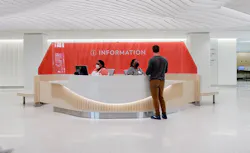
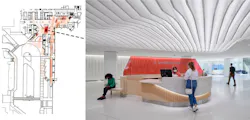
When it comes to physical check-in kiosks or information desks, a GBBN research study at UC Health Medical Center (UCMC) in Cincinnati demonstrated the value of strategic placement: an information desk located at the intersection of four major pedestrian routes became a natural hub.
A post-occupancy evaluation of our renovations at UCMC showed higher traffic and visibility at this location, allowing staff resources to be concentrated efficiently while making help easy to find. Open space allows people to clearly see landmarks like the information desk or registration area as they enter the building. This clarity lets them see their destination and choose how they will arrive there.
Integrating security without intimidation
Security is an unavoidable challenge for many hospitals today, particularly at major entry points. The goal is to enhance safety without making security the dominant first impression. This requires early collaboration between designers, operations teams, and security professionals.
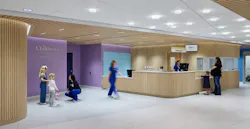
At Children’s Minnesota in Minneapolis, our renovation to their emergency department incorporated weapon detection into a new vestibule while keeping security staff adjacent rather than front-and-center.
Wall-mounted material (bamboo in this case) guides patients and families through the corridor which also provides clear sightlines to emergency check-in.
Security remains approachable and effective with a desk camouflaged by the same material, making their presence visible but not intrusive. Applying principles from Crime Prevention Through Environmental Design (CPTED) helps balance safety, visibility, and comfort—protecting patients and staff without sacrificing a welcoming environment.
A Holistic Approach to Healthcare Wayfinding and Campus Design
Patients navigating large healthcare campuses face multiple challenges: parking, wayfinding, registration, and security among them. Addressing these issues in isolation limits impact.
Architecture offers the opportunity to create a comprehensive, human-centered solution—one that reduces duplication, clarifies movement, improves visibility, and supports both operational efficiency and patient confidence.
When circulation is clear and intuitive, patients feel calmer, staff work more efficiently, and hospitals strengthen the relationship that matters most: trust.
About the Author
GBBN
We combine creative tenacity, technical mastery, and a global perspective to deliver design solutions that help our clients achieve their goals. Together, we shorten the distance between medical breakthroughs and patient bedsides, set students up for success, connect audiences and artists, and inspire employees to do their best work. At GBBN, we see architecture as mor than just buildings, because positively affecting people is the most important thing we do. Follow GBBN on Facebook, Instagram, LinkedIn, and Twitter.