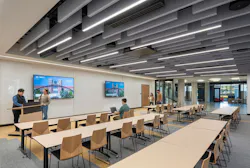
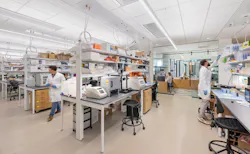
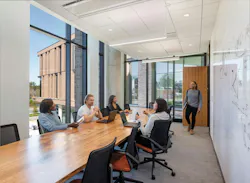
Florida State University’s new research building expands the school’s renowned commercialization programs
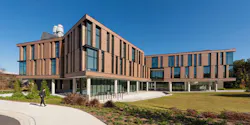
Florida State University’s new Interdisciplinary Research & Commercialization Building (IRCB) expands the school’s nationally renowned commercialization programs. IRCB’s collaborative environment supports increased invention disclosures, advances patents, and nurtures spin-off companies doing cross-functional research.
Designed by HGA, the 116,000-sf facility on FSU’s Innovation Park campus brings together faculty, researchers, and students working in materials science, energy, light, quantum science, engineering, and nanoscience. With mostly open laboratory spaces, the three-story building can accommodate up to 30 research groups, 24 postdoctoral researchers, and about 155 graduate and undergraduate students.
At a construction cost of $107 million, IRCB groups cross-disciplinary teams around shared themes and initiatives. Its adaptable design allows the facility to evolve with changing research priorities, funding, and scientific focus.
“From the outset, this facility was about creating a building that could adapt over time,” Breana Werner, design principal on HGA’s Science + Technology team, said in a statement. “IRCB demonstrates how nimble designs can adapt to changing funding, shifting research priorities, and emerging fields like FSU’s growing focus on quantum science, without compromising the original vision.”
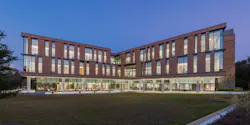
The building’s red brick in varied tones, as well as its precast accents and pitched roof, nod to the Collegiate Gothic style of FSU’s main campus.
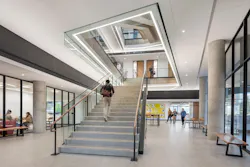
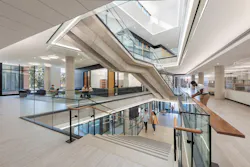
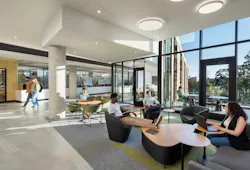
A central monumental staircase through all three floors offers visibility into student and research labs while encouraging informal interaction. Transitional workspaces, kitchenettes at corridor ends, and collaborative spaces also promote social encounters on all floors.
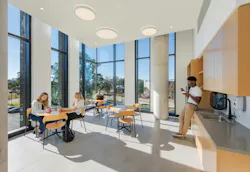
Each level provides natural light and views of the outdoors, supporting intuitive wayfinding and orientation. As a neuro-inclusive environment, the building offers smaller, acoustically controlled spaces for focus, privacy, and security.
LEED Silver certified, IRCB incorporates sustainable design strategies, such as energy-efficient systems, that were tailored to Florida’s environment. Trees removed during construction were repurposed as custom furniture. Also, the building’s mechanical systems and penthouse infrastructure can withstand high wind conditions and protect quantum-focused work and other vibration-sensitive research.
The project anticipates future development phases on adjacent parcels.
On the building team: Florida State University (owner), HGA (design architect and architect of record), Affiliated Engineers (MEP engineer), Walter P Moore (structural engineer), Acentech (vibration consultant), Whiting-Turner (general contractor).