6 design lessons from first-generation students every campus should embrace
For many first-generation students, arriving on campus means navigating unfamiliar systems, unwritten expectations, and new responsibilities without the benefit of family experience to help guide them. At the same time, these students bring strengths that institutions value deeply, including resilience, adaptability, determination, and initiative.
Recent conversations with fellow first-generation graduates helped shape more intuitive, supportive, and inclusive campus design strategies, leading to a clear conclusion: First-generation students do not need lower expectations, but campuses that are clearer, more welcoming, and more responsive to the realities they navigate every day.
Designing for first-generation students is a powerful lens for improving the campus experience for all students.
1. Make the Hidden Curriculum Visible
First-gen students often arrive on campus without inherited knowledge about how college works. Learning when to attend office hours, where to find tutoring, how to navigate orientation, and which services matter most often becomes trial and error rather than guided introduction.
“As a first-generation student, your greatest disadvantage is not lack of ability, but lack of familiarity with the hidden curriculum of higher education,” said one first-gen graduate.
This distinction matters deeply in planning and design. Too often, campuses are organized around institutional logic instead of user experience. Buildings are named in ways that mean little to new students, and support services are distributed across disconnected locations. While essential to student foundation, orientation often compresses too much information into a brief time and assumes an understanding students may not yet have.
For planners, architects, and institutional leaders, this points to a clear imperative: Clarity is not just a communication issue, but an equity issue. A campus that is easier to understand lets students direct more energy toward learning, connection, and growth rather than simply figuring out how the institution works.
2. Belonging Happens in Real Places
First-gen students do not describe belonging in abstract terms; they describe it through physical spaces and everyday interactions.
A faculty office with couches and a coffee table became a place where one student felt seen not just as a scholar, but as a person. Dorm lounges created camaraderie and informal peer support, while libraries with quieter, low-light areas offered comfort, focus, and even a safe place to rest during demanding periods. Student groups, leadership programs, fitness and wellness spaces, and mentorship structures also gave students opportunities to find community, ask questions, build confidence, and engage campus life beyond the classroom.
First-gen students’ stories reinforce an important truth: belonging is spatial as well as social. It is built through environments that feel approachable, calm, and convenient to access. The most meaningful spaces are often informal places where students gather casually, receive encouragement, and build trust over time.
Their location matters as much as their design. When gathering spaces are located near academic buildings, residence halls, or shuttle stops within a short walking distance, students are more likely to stop by, wander in, and participate, even if only briefly at first. That ease of access can lower the barrier to connection, especially for students who may be more hesitant to insert themselves socially.
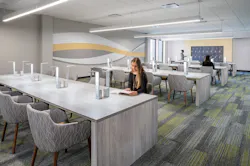
At USF’s Taneja College of Pharmacy, extended learning alcoves outside the clinical lab and quiet reading rooms offer welcoming spaces where students can pause, study, connect, and recharge. Thoughtful design elements like natural light, interior glazing, and comfortable furniture create a supportive environment that recognizes diverse academic needs and fosters a sense of belonging beyond the classroom.
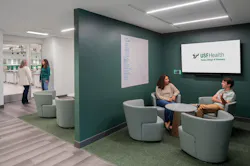
Designers should think beyond buildings as isolated program containers. The connective tissue of campus matters. Lounges, support hubs, informal meeting areas, faculty interaction zones, and quiet retreat spaces all contribute to whether students feel they are expected and welcome.
3. Intuitive Design Can Reduce Cognitive Load
If campuses are difficult to read, the burden falls on students to fill in the gaps. For first-gen students, that burden can be especially heavy.
First-gen students pointed to orientation and wayfinding as common friction points, noting that orientation was confusing because instructions seemed to assume students already understood the campus. Others emphasized the value of interactive maps, clearer guidance on where students would need to go in their first few months, visible welcome points and stronger digital tools for navigation.
These observations suggest that intuitive design is a student success strategy. The more transparent the campus experience, the less time students spend decoding systems and the more capacity they have for academics, relationships, and professional development. To alleviate circulation issues and unify Rand Hall and the Sarratt Student Center, Vanderbilt University established a clear path of travel through the main level of the building. Now, Rand Hall provides students with a new, multipurpose area that is distinctly Vanderbilt in its function and appearance. The design team’s innovative solutions allow students and staff an opportunity to enjoy a cohesive, organized, comfortable and diverse space.

Design responses can be both high impact and practical. Institutions can create clearer arrival sequences, interactive wayfinding tools, visible student service zones, and welcome environments that orient students gradually rather than overwhelming them. The goal is not to eliminate complexity, but to make the path through it more legible.
4. Consider the Realities of Student Life
First-gen students often experience college alongside work, financial pressure, commuting, and family obligations. Their needs are shaped not only by the classroom, but by everyday life.
These students often rely on campus grocery options, shared tools and supplies, affordable off campus parking, shuttle systems, open computer labs with costly software, and 24-hour library access. They also need healthier food, flexible commuting, low-cost social activities, and practical support during transitions such as moving off campus and setting up utilities. Though these may seem peripheral, their mental load shapes whether students can fully participate in campus life.
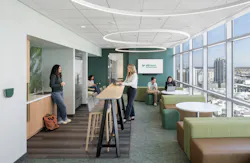
This is where campus design and planning matter. Support for student success should include spaces and services that address real daily needs. At USF’s Taneja College of Pharmacy, cohort-dedicated student lounges are equipped with soft seating, kitchenettes, and daylight views offering first-gen students welcoming spaces to rest, study, socialize, and recharge between classes and work. Along with access to affordable food, flexible study areas, commuter-friendly amenities, and practical service touchpoints, these spaces help reduce stress and boost student engagement.
What Students Actually Asked For
Across interviews, students consistently highlighted practical, low-cost, high impact supports such as:
- 24-hour or extended-hour library access
- Comfortable “sticky spaces” for rest and connection that encourage students to linger, socialize, and collaboration
- Affordable and healthier food options
- Distributed amenities such as lockers, water fill stations, and service points
- Bike repair stations in addition to bike racks
- Shuttle routes with evening coverage
- Open labs with high-cost software access
5. Build Career Confidence into the Campus Experience
For first-gen students, professional development often includes another set of unspoken rules. Career fairs, networking, interviews, and professional etiquette may feel unfamiliar even to highly capable students.
Support that eases the navigation of these expectations has proven to be invaluable. “Resources such as free suit rentals for career fairs, mock interviews, career advisors who helped shape my elevator pitch, and co-op programs led directly to opening doors to employment and professional licensure,” said one first-gen graduate.
These insights suggest that career readiness should not stand apart as an isolated service. It should be embedded in the campus environment. Spaces for mock interviews, mentoring, employer engagement, and professional skill building can help make career development visible, routine, and accessible.
For institutions focused on long term student success, this is a critical design opportunity. The campus can help students not only earn a degree but allow them to envision themselves stepping confidently into their next chapter.
6. Use First-Generation Students as Your Design Partners
The most valuable lesson for designers is that first-gen students are not only a population to support; they are also a source of insight.
Because they encounter campus with fresh eyes, they often notice first when systems are unclear; spaces are hard to navigate, or support structures depend too much on insider knowledge. They can identify where the student experience feels intuitive and where it quietly assumes too much.
That perspective is invaluable for institutions seeking to create more effective and inclusive environments. Engaging first-gen students in planning, programming, and post-occupancy feedback can help reveal blind spots that might otherwise go unseen.
Designing with first-gen students in mind leads to campuses that are easier to navigate, more welcoming to diverse experiences, and more aligned with the realities of student life.
A Stronger Campus for Everyone
The most meaningful interventions on campuses today do not have to be dramatic to be thoughtful. Design and planning decisions like a buddy program that provides regular check-ins, a quiet lounge that encourages informal connection, a library with hours that align with student schedules, and healthy, affordable food all contribute to a supportive environment, while orientation tools designed to inform without overwhelming, along with approachable career services, further help students transition from uncertainty to confidence.
First-gen students should not have to succeed by compensating for institutional blind spots. The opportunity is to create campuses that meet those strengths with equal intention. When we do, we create places that are more intuitive, more equitable, and more effective for all.
About the Author
Alyson Mandeville is a planner and designer focused on creating campus environments that support student success, belonging, and long-term institutional resilience. As Gresham Smith’s Education & Research practice leader, her work explores how design can remove barriers, amplify strengths, and shape more equitable experiences across higher education.