What hyperscale data centers teach the construction industry about speed, scale, and execution discipline
Across industries, owners are being asked to deliver critical facilities faster than ever—without sacrificing cost certainty, safety, quality, or operational readiness. That pressure is redefining construction.
Owners are asking teams to overlap design and procurement, release early work packages, and make major decisions sooner than they would have just a few years ago. They’re also still expecting predictable costs, clean turnover, and smooth commissioning amid labor constraints and supply-chain variability. Given the speed-to-market pressures and accelerating pace across the industry, construction is having a bigger impact on how businesses perform. For builders and owners alike, delivery strategy is now business strategy.
While projects need to move faster, speed alone isn’t enough. Teams must be organized to deliver that speed in a way that’s consistent and predictable. In life sciences and healthcare, research programs and patient capacity depend on facilities coming online when promised. In advanced manufacturing, production targets are directly tied to turnover dates. When a project delivery date slips, consequences extend beyond construction and into operations.
Large-scale data centers concentrate these pressures—and add scale, power density, and technical complexity—into an environment with little tolerance for volatility. That makes high-velocity data center programs a proving ground for delivery practices across the built environment.
Having delivered high-velocity data center programs for clients, such as Crusoe and Meta, we’ve seen how these demands are reshaping project delivery more broadly. Our industry has a choice: treat these approaches as exceptions or build the discipline to deliver speed with certainty and act as a true business partner.
6 Delivery Strategies for Building Faster Without Sacrificing Certainty
The six lessons below are not data center-specific “tricks,” but part of a new operating model for rethinking how projects are planned and executed, how decisions get made, and how teams are aligned to support speed, safety, and better outcomes.
1. Treat Speed as a Systems Problem: Front-Load Decisions That Reduce Volatility
Fast projects are often discussed as if success simply means pushing harder in the field. High-velocity programs show the opposite: schedule reliability is largely determined upstream by decisions that eliminate rework and procurement ambiguity.
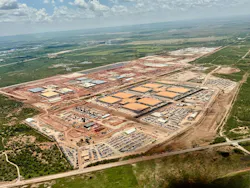
On Crusoe’s hyperscale campus in Abilene, Texas, Phase 1 included two buildings totaling roughly 980,000 sf at more than 200 megawatts of capacity, with a full buildout designed for up to 1.2 gigawatts. At that scale, labor, power, logistics, materials, and commissioning are parallel systems that must be planned together.
The practical takeaway is straightforward: speed comes from reducing decision latency. Teams that move quickly establish early paths to resolve the few decisions that drive the most downstream uncertainty.
In Abilene, the team aligned early on a multi-prime, risk-sharing delivery model and committed to breaking ground ten weeks after the first design meeting. Trade partners, including Rosendin and Southland Industries, were engaged early, and prefabrication partners, such as Digital Building Components and MPS, were brought into alignment while design decisions were still flexible. This early alignment reduced volatility and set the stage for execution.
The most successful fast-moving projects are not achieved by transferring more risk downstream. They depend on aligning the right partners early, structuring incentives around shared outcomes, and creating commercial terms that support strong execution. Too many owners still procure critical projects with methods designed for a slower era. They optimize for apparent price competition at the onset of a project in lieu of recognizing the final cost of the project is what matters most, all while unintentionally filtering out the speed, coordination, and top-tier talent they say they want.
2. Engineer Concurrency Across Structure, Envelope, Procurement, and Infrastructure
High-velocity data center programs force a level of concurrency that is increasingly relevant elsewhere: structure, envelope, procurement, and infrastructure advancing together instead of sequentially.
In Abilene, structural steel mobilized to site in roughly six weeks through early detailing and aligned procurement, while groundbreaking still occurred ten weeks after the first design meeting. The first two buildings, including eight data halls and two network cores, started with the initial turnovers in 11 months and all data halls were delivered in less than 18 months.
The lesson is not the calendar, but the system behind it: early partner alignment, accelerated detailing, constructability input before package finalization, and rapid, real-time decision-making. When those elements work together, schedule compression becomes a function of process discipline rather than field heroics.
Similar approaches apply in healthcare and life sciences projects, where early mechanical and electrical coordination helps resolve routing conflicts before framing limits flexibility—protecting commissioning milestones that are difficult to recover later.
3. Make Repeatability a Design Requirement
One reason large data center programs move quickly is that they are treated as programs, not a series of one-off buildings. Details are developed once and reused, allowing each future project and, even more critically, the teams designing/building them, to benefit from the lessons learned previously. Repeatability compounds. Crews move from one building to the next with greater confidence, fewer surprises, stronger safety performance, and more predictable outcomes because they are building on proven patterns rather than starting over.
Repeatability is more than an operations concept. It should be seen as a design, coordination, and procurement strategy. Standardized assemblies and interface details shift coordination from reinventing to validating, improving productivity, quality, and predictability at the same time.
Life sciences teams are also applying this through standardized lab modules and utility racks. In healthcare, repeatable patient room layouts and prefabricated headwalls bring consistency to spaces built dozens of times over.
4. Use Prefabrication as an Upstream Strategy
Prefabrication creates the most value when it is agreed upon early and aligned with a coordinated digital model. This way, it becomes more of a controlled production system that feeds the site plan rather than a late-stage schedule recovery tactic. When teams plan for it up front, it can simplify the work in the field, reduce congestion, and support a more predictable installation sequence.
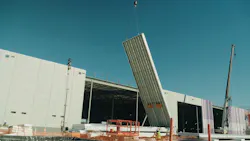
At Abilene, more than 600 prefinished exterior wall panels were built off site in roughly two months. After the team worked through sequencing and staging, installation that might normally take eight weeks was done in as little as seven days. Mechanical and electrical skids also arrived ready to set, which reduced work on site without driving up peak headcount.
We have seen the same thing on healthcare projects. On one recent hospital expansion in the Southeast, patient room headwalls and corridor MEP racks were built off site, moving roughly 35% of above-ceiling work into a more controlled setting. That cut in-room installation time by nearly 30% and helped the owner open beds on schedule.
5. Plan Workforce Strategy Around People
Large projects show that labor challenges are not always just about how many workers are available. The on-the-job experience can also directly impact progress, especially with high-velocity projects.
Congestion can lead to safety concerns and potentially costly errors. Craft workers must have the space and accessibility necessary to work safely and avoid congestion and overlaps with other teams.
At Abilene, peak site population reached approximately 9,500 workers, with typical days closer to 5,000–6,000. Headcount was clearly not the issue. The bigger challenge was making sure craft workers had safe access to spaces and materials and that multiple trades were not competing for the same constrained zones at the same time.
Headcount alone would not have protected productivity or the worker experience. The strongest approach pairs coordinated sequencing with off-site manufacturing, moving portions of the work off site and bringing them back ready to install. This helps reduce crowding, improve safety, and create the kind of project where both strong trade partners and skilled craft workers want to be.
6. Process Discipline Is the Real Competitive Advantage
The industry often looks to new technology to accelerate construction. High-velocity programs suggest that some of the biggest bottlenecks are process and decision structure, not tools alone.
AI infrastructure growth is placing delivery discipline under scrutiny and demonstrating that projects can move faster without sacrificing safety or quality when early alignment, repeatability, integrated prefabrication, and realistic workforce planning are applied with urgency.
That is what these projects are making clear. Speed depends on how the work is set up, how decisions get made, and how well teams execute together from the start.
Conclusion
Data centers may be where these pressures are most visible today, but the lessons from these projects apply much more broadly. Projects go better when teams make key decisions earlier, bring the right partners in sooner, repeat what works, use prefabrication where it makes sense, and plan the work around safety, access, and the craft worker experience. Those are useful lessons for hospitals, laboratories, factories, campuses, and other critical facilities too.
When we build that way, the impact goes well beyond the project team and the owner. Patients get care sooner. Research moves faster. Manufacturers come online earlier. Communities get needed spaces and services sooner. Craft professionals get safer, better-organized places to work. This is why it matters. The process of building directly impacts the operations of any space, making it critical not just for planning but also for long-term performance.