AEC report reveals firms are in the throes of AI transition

Few subjects trigger as much competitive curiosity—and as much angst and uncertainty—among architecture, engineering, and construction (AEC) industry executives as artificial intelligence.
Is our firm ahead of or behind the curve in terms of understanding and using AI? How are our peers using AI, and where within our business could and perhaps should we be utilizing it? Are there steps we can take to improve the output of our AI tools and maximize our AI investments? Are we best served using off-the-shelf AI tools, purpose-built ones, or developing our own?
Questions like these are top of mind for many AEC leaders nowadays. And the newly released 2026 AEC Inspire Report, a benchmarking study for the three industries, offers them a measure of clarity, not only about where the AEC business as a whole is headed with regard to AI, but also on a wide range of other strategically relevant trends and issues.
“With rapid-fire advancements in technology and AI layered on top of economic swings and slower-moving regulatory tides, many firms are still struggling to find safe footing on uncertain ground,” we observe in the Unanet report, of which I am co-author.
Documenting AI’s Ascension in AEC
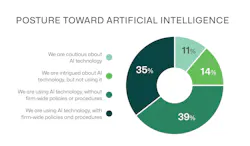
Findings from the report portray an industry in a state of transition caused in no small part by the rapid adoption of AI. Three-quarters of AEC firms now use AI, an increase of about 20% from last year.
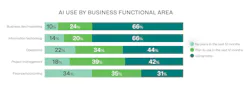
AEC firms most commonly use AI in their business development and marketing functions, and least in their finance and accounting functions. However, the data suggests we’ll soon see broader AI adoption in finance and accounting as well as in project management and general operations to support functions like forecasting, reporting, and project monitoring.
Firms most often access AI capabilities via widely available software platforms like Microsoft Copilot and Google Gemini and third-party tools like ChatGPT. About half use AI embedded in industry-specific software, where capabilities are more likely to be purpose-built for an industry and its unique workflows.
Interestingly, more than one-quarter (27%) indicate their firms are building their own in-house AI models and capabilities, while 17% are building integrations to generic AI models and 17% are developing their own agentic workflows. This suggests the emergence of a class of true technology leaders in AEC that are pushing the envelope by investing in, exploring and implementing AI.
What benefits do firms anticipate from their use of AI? The largest share—71%—expect it to result in improved employee efficiency. Almost two-thirds (64%) expect it to improve employee effectiveness. Meanwhile, just 13% anticipate workforce reductions as a result of implementing AI.
There’s an important distinction to note here between efficiency and effectiveness. The former speaks to quantity: AI can help employees generate proposals faster, for example. But it can provide a qualitative lift, too, by offering deeper insight to the proposal-development team about a specific RFP and the organization soliciting bids, who the bidding competition is likely to be for the pursuit, how the firm has typically approached similar pursuits and what the outcomes have been, and other information that can lead to better informed go/no-go decisions and higher-quality proposals.
As much promise as AI is showing in use cases like these, the AEC Inspire report sounds a cautionary note about the underlying fundamentals firms should have in place to guide and maximize their AI implementations. While AI adoption has accelerated, just 29% of firms report high confidence in the underlying data that feeds their AI tools. Suspect data can undermine the quality of a firm’s AI output, as the insights AI models produce generally are only as good as the data supplying those models.
One way to boost overall data quality is to democratize data management responsibilities and practices across the organization, whereby people across teams and departments are familiar with and follow clear practices and processes for capturing and managing data in the context of their day-to-day work. By putting these responsibilities in the hands of the many, not just a few within the organization, firms stand a much better chance of getting the most from their AI capabilities due to higher-quality data.
A Big-Picture Look at AEC Trends
The 2026 AEC Inspire Report reveals much about where the AEC industries stand today, where they’re heading, what firm priorities are, and what keeps execs awake at night. Here are some highlights:
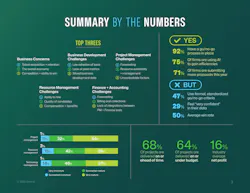
- Net profitability for surveyed firms has increased over the past two years and stands at 16% in 2026, up from 13% in 2024 and 15% in 2025
- Average firm revenue has softened slightly, to $256 million in 2026 from $260 million in 2025
- Generating new business is a high priority. A strong majority—71%—of respondents say their firms are submitting more proposals this year than last
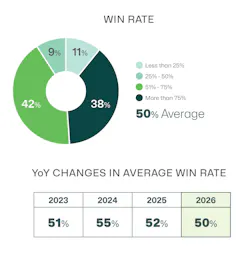
- While proposal output has nearly doubled, win rates have stagnated from 56% in 2024 to 52% in 2025 and 50% in 2026
Outlook on Business Environment
- Talent acquisition and retention remains AEC firms’ foremost business concern, followed by the economy
- AEC firms are more worried about winning new business than at any time in the last four years
- The vast majority (92%) of firms have some kind of go/no-go process for their new business pursuits, yet less than half (47%) say they follow a formal process in that regard
Despite mixed market signals and deep uncertainty across the AEC landscape, there’s plenty for architecture, engineering and construction firms to be optimistic about here in 2026 and beyond. Now it’s up to individual firms and their leaders to find creative, sustainable ways to grow, with the help of technology, data-informed decision-making and planning, and good old-fashioned business acumen.
About the Author
Lucas Hayden leads product marketing for Unanet’s architecture, engineering and construction solutions, helping AEC firms solve problems, drive innovation, and achieve scalable growth through AI-forward, purpose-built technology. Connect with him on LinkedIn.