How digital and virtual twins help buildings simulate and adapt to potential problems

This blog post was authored by Melissa Alexander, Principal and Consulting Senior Manager, Blue Cottage of CannonDesign; and F. Jeffrey Murray, FAIA, LEED AP, Principal and Science & Technology Practice Leader, CannonDesign.
What if your building had a second self—one that could think, adapt, and warn you before problems arise? Not just a mirror of its walls and systems, but a reflection of the people moving through it, the energy it consumes, and the way it flexes under stress.
This is the promise of the virtual twin: a living counterpart powered by real-time and predictive data, capable of simulating operations and anticipating future scenarios.
Digital twin vs. virtual twin
The term digital twin is widely used in the building design industry to describe a digital replica of a physical asset or system. However, most of today’s advanced applications go beyond simple replication. A digital twin is generally static—it mirrors the physical object and is often used for monitoring and record-keeping. A virtual twin expands on this concept by integrating real-time data, predictive modeling, simulation, and machine learning to create a dynamic environment where scenarios can be tested and decisions can be guided before implementation. In short, a digital twin shows you a mirror of what the object is, while a virtual twin lets you explore what could be.
While simulation modeling is fairly standard in the planning stages for capital projects, particularly for capacity and operational flow, the virtual twin can show how the building will be affected by multiple variables at once—from a high influx of patients into a hospital to a heat wave on a skyscraper.
By bridging existing digital information with the dynamic capabilities of virtual twins, the building owners and operators can create a continuous thread of insight that supports every step of planning out a building’s operations from early planning to construction coordination, to facility operations and long-term adaptation.
Virtual twin uses for building design and planning
In the earliest stages of design, virtual twins provide a powerful way to explore and test ideas before committing resources. By linking conceptual layouts with real-world data such as anticipated occupancy, space utilization, energy performance or staffing models, design teams and clients can simulate how a facility will function under different scenarios.
An emergency department virtual twin can test how patient flow and department capacity change if ambulance arrivals surge by 20% or there is an infectious disease outbreak. The virtual model can show how quickly waiting rooms fill, where bottlenecks occur and how staff assignments need to shift, long before any final design decisions are made.
This allows stakeholders to evaluate “what if” scenarios around space mix, adjacencies, technology integration and operational flow, all within a dynamic and visual model. Using this approach, project teams can uncover potential challenges, optimize design strategies, and build consensus early, ultimately reducing costly revisions later in the process while aligning the final design more closely with long-term goals.

Virtual twin uses for building operations
Once a facility is built and occupied, a virtual twin becomes a living tool for ongoing management and improvement. The twin not only shows how the building is performing in real time by monitoring user behavior, space utilization and more, but also tests the impact of design or operational changes, emergency drills and other disruptions. This can all be tested in the virtual twin environment, and does not require the time, money or manpower as “real life” simulations. Virtual twins can complement real life drills and not have to run them frequently.
If used correctly a virtual twin could reveal whether the current mix of spaces meets demand, how efficiently they are used and where opportunities exist for consolidation, expansion or reconfiguration. It also shows how staffing changes, program shifts or new technology will affect space needs, always in the spatial context of buildings, campuses or entire portfolios.
How we’re using digital and virtual twins in our work
While the potential for digital and virtual twins in the design process spans a wide spectrum of possibilities, the CannonDesign and Blue Cottage teams are utilizing it in specific case studies to bring the most possible value now and in the future.
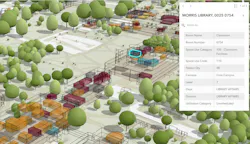
Our Blue Cottage of CannonDesign team currently builds virtual twins using the Esri suite of software, including ArcGIS Pro, ArcGIS Indoors, Experience Builder, and Dashboards. Esri is inherently spatial, flexible, and enterprise-ready, and many large institutions already have it in place, making it easier to implement and integrate. By working in the environment our clients already know, we meet them where they are, reduce adoption barriers, and help them get more from their existing investment.
By using a virtual twin in the strategic planning stages, the twin becomes a shared source of truth, fostering alignment between leadership, facilities teams, and users. Because it evolves with the organization, it reflects current realities while keeping sight of how to best implement long-term strategies. This living virtual twin does not just document the physical space. It equips an institution’s decision makers with the clarity and context to manage it proactively, adapt with confidence, and ensure that facilities continue to operate as intended.

Potential future uses
The future of virtual twin use in space and building planning and beyond is vast. There is the potential to pair digital twins with AI and machine learning as well as syncing it with other digital systems to further improve how users experience and interact with a building during the every day or doing certain scenarios or emergencies.
Ultimately, the value of virtual twins lies in its ability to improve the original existing entity, whether it is a building or engineering system or how someone uses a space. It can improve outcomes, create more efficiency and streamline complex processes. As technology and machine learning continue to rapidly advance, so too can the capabilities of a virtual twin in improving the operations and lifespan of the built environment.
About the Author
CannonDesign
CannonDesign’s Insights is a place for the global design firm to share thoughts and news related to their current efforts to help transform businesses, educational models and health paradigms. The firm engages diverse perspectives and expertise to deliver proven, innovative solutions to our most important partners, our clients. Our global network of more than a thousand professionals enable us to create design solutions to the greatest challenges facing our clients and society. Follow us on Facebook, Instagram, LinkedIn, and Twitter.