Above + Beyond: condo tower built atop parking structure
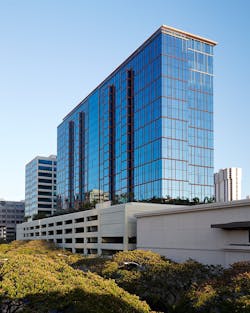
The structural challenges of building an 18-story tower atop an existing parking garage inspired an innovative design solution for the One Ala Moana condominiums in Honolulu.
About 10 years ago, General Growth Properties undertook the expansion of its Ala Moana Center, Hawaii’s largest mall. The retail market looked strong, and the developer was even able to add the Aloha State’s first Nordstrom department store to the shopping center. An adjacent five-story parking structure was completed in 2008, with the idea of building a luxury residential tower atop the garage. But the Great Recession—and General Growth Properties’ subsequent declaration of bankruptcy—put the kibosh on those plans.
In 2010 Howard Hughes Corporation acquired the rights to develop the tower as part of General Growth Properties’ bankruptcy reorganization. Hughes partnered with local developers The MacNaughton Group and Kobayashi Group on the project. Architecture firm Solomon Cordwell Buenz won the design competition to build the tower.
SCB’s foremost technical obstacle involved developing an efficient structural transfer system to address the misalignment between the column grids of the garage and those of the new tower. SCB and Magnusson Klemencic Associates, a structural engineering firm that had worked on the original parking garage, came up with a fresh approach to the problem. They proposed installing a series of 13-foot-tall steel trusses, each weighing more than 50 tons, to transfer the tower’s loads to grade.
“Unlike the original tower design, which proposed a large concrete transfer structure between the garage and residential tower, we wanted to make the transfer structure as light as possible so we could create habitable space along that structure,” says SCB’s Benjamin Wrigley, AIA, Senior Designer and Associate Principal.
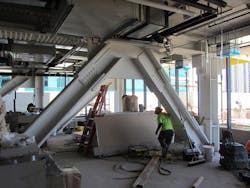
This system not only provided planning flexibility in column locations to make the most efficient use of residential unit layouts; it also enabled the transfer level on the garage roof to become an active floor of the new building.
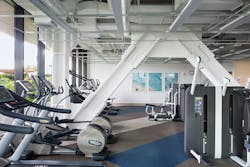
“We worked closely with SCB to help them configure the trusses on the transfer level to accommodate functional spaces between them,” says Peter Somers, PE, SE, a Principal in MKA’s Seattle office. The transfer level houses the building’s main lobby and amenities spaces, including a fitness center, media center, library, and wine bar.
The reconfigured design also made possible an amenities deck with a pool, a children’s play area, and a landscaped running track, all supported by long-span steel framing on the 60-foot parking column grid. Instead of these amenities taking up space higher up in the building, the new structural solution made it possible to add another floor of residential units. Says Wrigley, “That was obviously very appealing to the developers.”
Except in the fitness center and a couple of other spaces where they are intentionally exposed for aesthetic purposes, the steel trusses are integrated into the building walls, rendering them essentially invisible.
“You can walk through the entire sequence of trusses and not really know they are there,” says Wrigley. “That space became very dramatic.” So dramatic, in fact, that the owners, who are serious art collectors, created a gallery space to display their art collection.
Additional design opportunities emerged from a technical analysis of the parking structure to reassess its true load capacity.
“We tested the foundations, including the soils and the hardness of the concrete, and found that the structure had a higher bearing capacity than the original design had allowed for,” says SCB Principal Chris Pemberton, AIA, who directs the firm’s San Francisco office. “That meant we could design a wider building and introduce some indoor-outdoor spaces and lanais off the residential units that we hadn’t anticipated as we started the project.” It was, he says, “a pleasant surprise.”
SHAPING THE EXPERIENCE
The arrival experience at One Ala Moana is luxurious. An express elevator in the garage transports residents to the lobby, where it splits into two separate elevator cores, similar to a sky lobby in a high-end hotel.
“We took a long building—almost the length of a football field—and divided it into two elevator cores, north and south,” says Pemberton. “That allowed us to break the floor plan down and have the majority of the units face the ocean, which created a lot of value for the developers.”
The 205 residential units sold out within a few days after hitting the market in late 2014. “The key to the success of the project was that we were able to make it invisible that we were building on top of a garage,” says Pemberton.
SCB is making use of the knowledge it gained from the One Ala Moana experience. “The heightened level of luxury presented by a twin-core residential building is something we applied to the next project we did in Honolulu, with great success,” says Pemberton.
Constructing over existing structures is becoming increasingly common, particularly in dense urban areas, says Shelley Clark, PE, SE, Senior Principal in MKA’s Seattle office. “Any time you add to an existing building, you try to minimize whatever upgrades you need to do to make it happen,” she says.
“On this project, we were able to adaptively reuse the existing parking garage framing and integrate the expansion capacities of the existing columns, walls, and foundations,” says Clark. “But there’s no stock solution. You have to figure out strategies to minimize construction costs and how much upgrading and rebuilding is required.”