Streamline Design-build with BIM
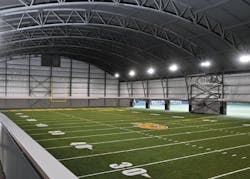
Last fall, the design-build team for Georgia Tech’s new indoor football practice facility was given just 40 weeks to design and construct the John and Mary Brock Football Facility in Atlanta. The design-build team led by project management firm Barton Malow won the job on October 15, 2010, and the 88,000-sf facility had to be ready by August 1, 2011 in time for the new season of Yellow Jackets’ Football. The $9.75 million new practice facility would also have to be accessible to Georgia Tech officials, boosters, and recruits considering committing to the program the summer before it opened.
“Our sole focus was minimizing risk to deliver the project on schedule,” said Jason McFadden, project manager for Barton Malow. “We weren’t using BIM to show clash detection or make a pretty model.”
At the kickoff meeting last October, Barton Malow and other members of the Building Team—architect Knight Architects of Atlanta, structural engineer Walter P Moore, and owner representatives from Georgia Tech and construction partner May Moeller Purcell—signed memos that committed each discipline to specific completion dates for the various phases of the project. They also set up a workflow where the entire team had to go through the BIM model together on a weekly basis. Most important, the team agreed on a set of tools to model in, collaborate, and deliver closeout documents—a combination of Tekla Engineer and Detailing packages and Tekla for Construction Management to manage and track project status, including submittals, RFIs, and scheduling. Subsequently, TeklaBIMsight for collaboration was added.
At that initial meeting, the Building Team decided that designing a building that was mostly structural steel (rather than a prefabricated metal building) would be the only way to deliver on the tight schedule. Shortly thereafter, Barton Malow published an RFP for steel fabricators challenging them to explain how their system would most benefit the project. The Atlanta office of SteelFab won the project and committed to using Tekla for direct design-to-fabrication as outlined in the RFP.
Walter P Moore started development of the steel model in Tekla Structures in early December. By December 8, 2010, the first model was out to the Steelfab team. The process ran smoothly from that initial model exchange, since both the engineer and fabricator were using native Tekla Structures files. The final, fully detailed design model was approved by Walter P Moore on January 8, 2011. Only 12 weeks separated the start of steel design to the start of steel erection.
Truss sections were determined by what could be shipped and built on the tight site on Georgia Tech’s campus. Each 228-foot truss was divided into six equal sections, which were delivered and bolted together on the ground at the site. The stair tower and camera platform, including rails, were all fully modeled in Tekla.
“The key was continuous back-and-forth information exchange,” McFadden said. Steelfab suggested several fabrication techniques that really allowed us to achieve our schedule goals.
The Tekla Model Reviewer was used early in the steel design, but once TeklaBIMSight was released last February, the Building Team quickly adopted it as its collaboration tool. Ambassador Steel of Waukesha, Wis., was chosen as the concrete rebar fabricator; however, the concrete foundation design was delayed because a geotechnical report was not delivered until December 7. That cut the team’s schedule to three weeks for completion of concrete design and one week to complete the reinforcing bar detail shop drawings.
“We gambled a little bit with publishing approved rebar shop drawings prior to the concrete subcontract award,” McFadden said. “That’s not yet very common in the eastern part of the country but Ambassador Steel really came through.”
Ambassador and Walter P Moore delivered a full rebar model for the foundation by December 30. It took only eight days from the time the concrete subcontract was awarded to get rebar on site. The structural engineer modeled all concrete reinforcement and shared it with Ambassador Steel in Tekla to streamline the rebar detailing process. Ambassador also produced reinforcing bend diagrams directly from the model. The concrete model was integrated with the steel and electrical model by late January. By that time TeklaBIMsight was being used as the collaboration tool and model viewer of choice. Tekla BIMsight was also taken out into the field in tablet computers to match up the model to work in the field. With both rebar and steel design, the model exported directly to the fabricator’s production equipment.
The integrated models were used for scheduling and erection planning sequencing with Tekla’s Construction Management solution, which also provided a tool to evaluate erection plan and sequence.
CREATING A VISUAL REPRESENTATION
To coordinate the schedule, the Barton Malow team used model-based color-coded timelines for scheduling and just-in-time delivery. The Suretrak schedule was integrated with the Tekla task manager to provide a visual representation of all completed and upcoming construction tasks. Custom reports were created using the BIM model to streamline a two-week look-ahead for installation of each component of the building. No paper approval documents were used on the project until file record copies were needed.
The Tekla Model Reviewer and BIMsight from tablets and computers in the field were used to document and discuss all construction problems in the field. Thanks to the weekly meetings and detailed project memos from design to construction there were no clashes at any point in construction. Last August 1, the new practice facility opened on time and on budget.
“We’re not necessarily trying to have every project engineer or project manager or superintendent having to learn a particular BIM software, but for every project team to be using BIM technology in the way that’s right for their job,” said Phil Kirby, Barton Malow’s senior vice president. “We don’t have a one-size-fits-all solution because every job is different. What we have found is that prefabrication can be applied to most jobs, and choosing the right tool to enable that is what worked at Georgia Tech.” BD+C
--
Contributing Editor Jeff “BIMBoy” Yoders blogs on BIM and related IT topics at www.BDCnetwork.com.