Hoboken Terminal restoration complete
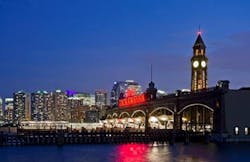
Restoration of ferry slips, expanded service to benefit commuters.

The second phase also included marine construction of five of the original six ferry slips, as well as restoration of the exterior copper facade and lighting on the river side of the terminal, structural repairs, roof repairs and demolition of the finger piers and wooden fenders.

New Jersey Department of Transportation Commissioner and NJ TRANSIT Board Chairman James Simpson and NJ TRANSIT Executive Director James Weinstein joined local, state and federal officials recently celebrated the completion of a project that returned a portion of Hoboken Terminal to its original design—restoring permanent ferry service to the historic building. 

The historic, Beaux-Arts style terminal and its ferry slips were originally built by the Delaware, Lackawanna and Western Railroad in 1907. Hoboken ferry service was discontinued in 1967 due to declining demand, but was reintroduced in 1989 at a temporary facility at the southern end of the terminal building. 

In early 2003, NJ TRANSIT and the Port Authority entered into an agreement to allow for the restoration of the Hoboken Terminal ferry slips and supporting infrastructure, with the goal of returning ferry service to its original location, while protecting and enhancing the historic elements of the terminal.

The $120 million project, funded through a mixture of state, federal and Port Authority funding, was divided into three phases. The first phase, which began in April 2004 and was completed in September 2005, included repairs to the terminal’s substructure and superstructure.

Work on the second phase began in December 2005 and was completed in April 2008, including construction of a 230-foot tall clock tower replica modeled after the original 1907 design by architect Kenneth Murchison. In homage to the original, the clock tower includes four-foot-high copper letters spelling out the word “Lackawanna” and is surmounted by an illuminated clock with four 12-foot diameter faces, one on each side of the tower. 

The second phase also included marine construction of five of the original six ferry slips, as well as restoration of the exterior copper facade and lighting on the river side of the terminal, structural repairs, roof repairs and demolition of the finger piers and wooden fenders.

Construction of the ferry boarding area was completed in the third and final phase, along with all remaining work necessary to restore ferry service to the original slips, including work on utilities, lighting, the ticketing area, ferry barges and gangways. 

NY Waterway, owned and operated by Port Imperial Ferry Corp and Billybey Ferry Co., will be providing service from the ferry slips. NY Waterway provides the largest privately-owned commuter ferry service in the U.S., carrying 35,000 passenger trips per day – 8 million trips per year, including service between New Jersey and Manhattan. 

Hoboken Terminal currently provides travelers multiple transit options including commuter rail, light rail, bus, PATH and ferry service. Nearly 60,000 people use the terminal on a typical weekday. BD+C


Comments on: "Hoboken Terminal restoration complete "

The colorful ribboned flooring at Toronto’s Corus Quay mimics the iconic corkscr
Discussions of commercial flooring tend to focus on the floor covering or finish material. This is hardly surprising, since the covering is the part of the floor that stakeholders see, interact with, and care about most. The...
The use of light load-bearing glass to create transparent stairs, floors, and ot
Glass has taken on new life in recent building years. Long valued for its transparency and lightness, glass is now also being considered for its structural and protective capabilities. Beyond the technique known as...
Building owners must plan ahead for roof replacement to avoid emergency leak rem
No building owner wants to be caught unprepared by catastrophic roof failure. Emergency roof replacements tend to be more expensive than planned ones, and damage to interiors may mean unrecovered costs and detrimental...
AIA: New Developments in Concrete Construction
Concrete has long been a reliable building material for commercial and institutional projects. Yet recent trends, including the growth in hospitality and urban rental project starts, as well as mixed-use towers and transit-...
AIA Rainscreens BD+C DEcember 2011
Until recently, it has been lighting, mechanical, and control system upgrades which have received the most attention in the green building movement. At long last, the industry is now recognizing building enclosures as a long...
Brick and stone masonry have served as reliable and valuable elements of commercial building projects for centuries, gracing urban and rural landscapes since time immemorial. Building Teams have trusted clay brick to bring...
Making the Most of the Reconstruction Boom Reconstruction in its many forms—tenant improvements, retail fitouts, adaptive reuse, historic preservation, gut rehab, and so on—is keeping many design and construction firms...
The topic of water shortages is nothing new, as cities around the globe struggle with drought, water quality, supply constraints, and failing infrastructures. However, the idea of new plumbing codes and design standards...
Guard booths, stations and shelters are defense strategy linchpins, becoming increasingly integral to perimeter defense planning. Before evaluating the efficacy of different guard booth configurations, and before selecting a...
From the company that brought you Construction Computing Magazine’s 2011 BIM Product of the Year ArchiCAD 15, the “Get There Faster with ArchiCAD” whitepaper examines five critical areas to explore before making your final...
Download Complete White Paper Download Introduction Download Chapters 1-4Defining Net-Zero Energy Buildings
Our seventh White Paper on Green Buildings focuses on the role of water in sustainable design and construction. The editors conclude with a set of 21 detailed recommendations for the consideration of the Building Teams, home...