Blueprint for a New Energy Future
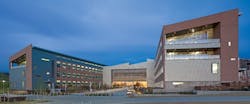
The U.S. Department of Energy’s Research Support Facility (RSF), in Golden, Colo., is arguably America’s most significant building of the last decade, at least in terms of energy consumption.
The 222,000-sf, slanted H-shaped office building, on the site of the DOE’s National Renewable Energy Laboratory, is designed to produce as much or more energy than it uses—to be specific, 35 kBtu/sf/year, which is 50% below ASHRAE 90.1-2004. The building, which also includes a data center that serves the entire campus, can accommodate 825 staff; it provides 61% more space to the NREL building stock yet adds only 6% in energy demand (which is provided by PVs). Yet the building itself came in at $57.4 million ($259/sf) in construction costs, with a total contract cost of $64 million, including campus utilities and infrastructure—$288/sf.
More importantly, the Building Team achieved these remarkable numbers through rigorous energy-conservation methods that brought the RSF’s energy use down by about 80% compared to a conventional building. Only after all energy-saving strategies were applied were renewable energy sources used. Only readily available, made-in-the-USA products, technologies, and systems were used.
The DOE and NREL held a national design competition to pick the team, setting forth 26 project objectives in a fast-track, multi-bid proposal. Three objectives were deemed “mission critical”: a LEED Platinum rating, Energy Star First “Plus,” and safe work performance. The other 23 were termed “highly desirable”—such as providing room for up to 800 staff—or “if possible,” notably net-zero energy use, “most energy-efficient building in the world,” and a LEED Platinum “Plus” rating. Moreover, the project had to demonstrate that a distinctively new class of real estate was feasible and replicable by the private sector.
The winning team, led by design firm RNL and GC Haselden Construction (with engineering from Stantec Consulting), vowed to meet or exceed all 26 objectives. This was risky, since the team would be paid only 50% of the cost of completing the preliminary design; if the DOE didn’t like it, the feds could terminate the contract with no additional payment.
The Building Team evaluated and tested a multitude of technologies before choosing the systems that would go into the structure. These included hydronic radiant slab heating and cooling employing 45 miles of piping; a below-grade maze of heavy concrete structures to store thermal energy for passive cooling and heating; a dedicated outside air system that provides fresh air via raised floors when the windows are closed; and a thermally massive exterior wall system using insulated precast tilt-up panels.
Modular workstations, raised floor systems, and demountable walls were tested via full-scale mockups to provide optimal daylighting, thermal comfort and control, sound control, and indoor air quality. Occupied spaces are no more than 30 feet from an operable window. A mechanical system automatically opens a third of the windows on cool summer nights.
Working intensively with subcontractors, the team installed a standing seam metal roof 90 days ahead of schedule so that photovoltaics could be installed on time. Two of the technologies used in the RSF—transpired solar collectors and electrochromic windows—were co-developed by NREL scientists. Nearly 600 windows were placed, many of them crowned with specially designed “bonnets” to control interior heat buildup (see http://www.bdcnetwork.com/article/windows-keep-green-goals-view).
As impressive as the technological innovations were, the real breakthrough had to do with the team’s embrace of the DOE performance-based procurement process. In a radical departure from standard DOE procedures, the Building Team negotiated with DOE over a two-month period to redefine standard construction contracts, federal acquisition regulations, and RFP contract terms.
The final contract contained more than a dozen specially crafted clauses, and the new contracting method—performance-based design-build—proved so successful that it has become the new NREL model for subsequent high-performance DOE construction projects, including a new building at NREL that Haselden and RNL are working on. In fact, the team’s performance was rated “superior” on each of the 26 objectives, qualifying them for $2 million in contract incentives.
“This would have to be one of the most collaborative projects I’ve seen in recent years,” said Building Team Awards juror Michael Damore, AIA, Executive Managing Director of A/E firm Epstein, Chicago. Said J.A. Detamore, PhD, PE, PMP, Director, NREL Infrastructure and Campus Development, “The level of innovation and creativity that went into this [project] is simply outstanding. The project represents the highest level of partnering I have ever been part of in my 29 years of experience.”
The lesson of the NREL Research Support Facility is clear: If the U.S. government can build a net-zero energy office building at market-rate cost, why can’t the private sector do so?
For more on this topic, see “Zero and Net-Zero Energy Buildings + Homes."